

Nearly half of the organizations onboarded into the crypto industry in 2026 are operating at alerting standards that would have made them industry leaders only a few years ago, according to Chainalysis.
In a preview of a report published on Wednesday, Chainalysis said that the crypto industry’s compliance baseline around alert severity, trigger sensitivity and minimum dollar detection floors is tightening, with about 47% of organizations onboarded this year using alerting standards that would have placed them in the top 10% of strictness in 2020.
It added that companies have become more uniform in direct monitoring, where funds arrive immediately from a known illicit source, but there is still a gap with indirect monitoring, where the funds pass through intermediary addresses.
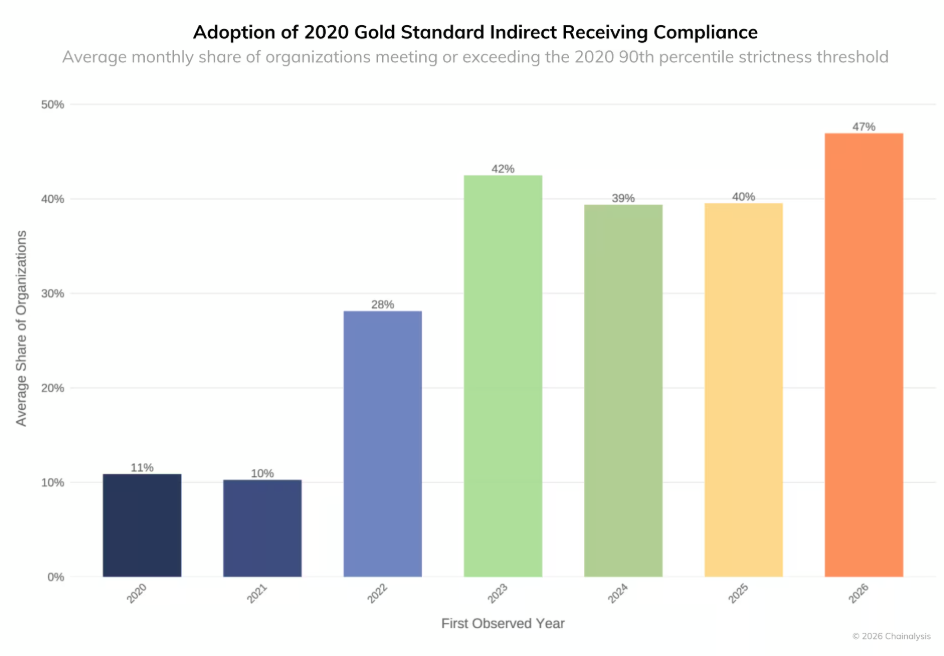
Compliance-alerting standards have improved significantly across the industry over the last few years. Source: Chainalysis
The industry has been raising its security and compliance in response to stricter regulations and growing threats from hackers. North Korean-affiliated hackers alone were responsible for an estimated $2 billion in crypto losses in 2025.
Chainalysis said that in 2020, the industry was still establishing norms, with only 10% meeting the top requirements. However, the rate started increasing in 2023, and now “newer entrants are launching with more aggressive monitoring.”
“This is a sign of rapid ecosystem maturation. Standard compliance configurations today would have been considered industry-leading just five years ago. The industry financial institutions are joining has already built substantial compliance infrastructure, and the bar continues to rise.”
Crypto has a gap in indirect monitoring
Legacy financial institutions have lower triggering thresholds for indirect exposure to both illicit and non-illicit fund flows and are alerted to smaller sums. On average, crypto exchanges set much higher alerting thresholds, and the thresholds vary across categories, according to Chainalysis.
Related: Coinbase execs face new lawsuit seeking damages, insider profit clawbacks
Categories such as ransomware, fraud shops, scams and darknet markets often have indirect thresholds 10 to 20 times higher than their direct equivalents.
“The industry’s gap between direct and indirect monitoring creates an opening for illicit actors to exploit. Organizations that close this gap improve their regulatory defensibility and differentiate themselves as trustworthy counterparties,” the Chainalysis team said.
“The data in this chapter point to an industry in transition, one that has professionalized its approach to direct exposure but which may not yet be treating indirect risk with equivalent rigor.”
Magazine: Polymarket seeks Japan entry, Harvard dumps entire ETH position: Hodler’s Digest, May 17 – 23
Latest News#Crypto #companies #tightened #compliance #gaps #remain #Chainalysis1779955946