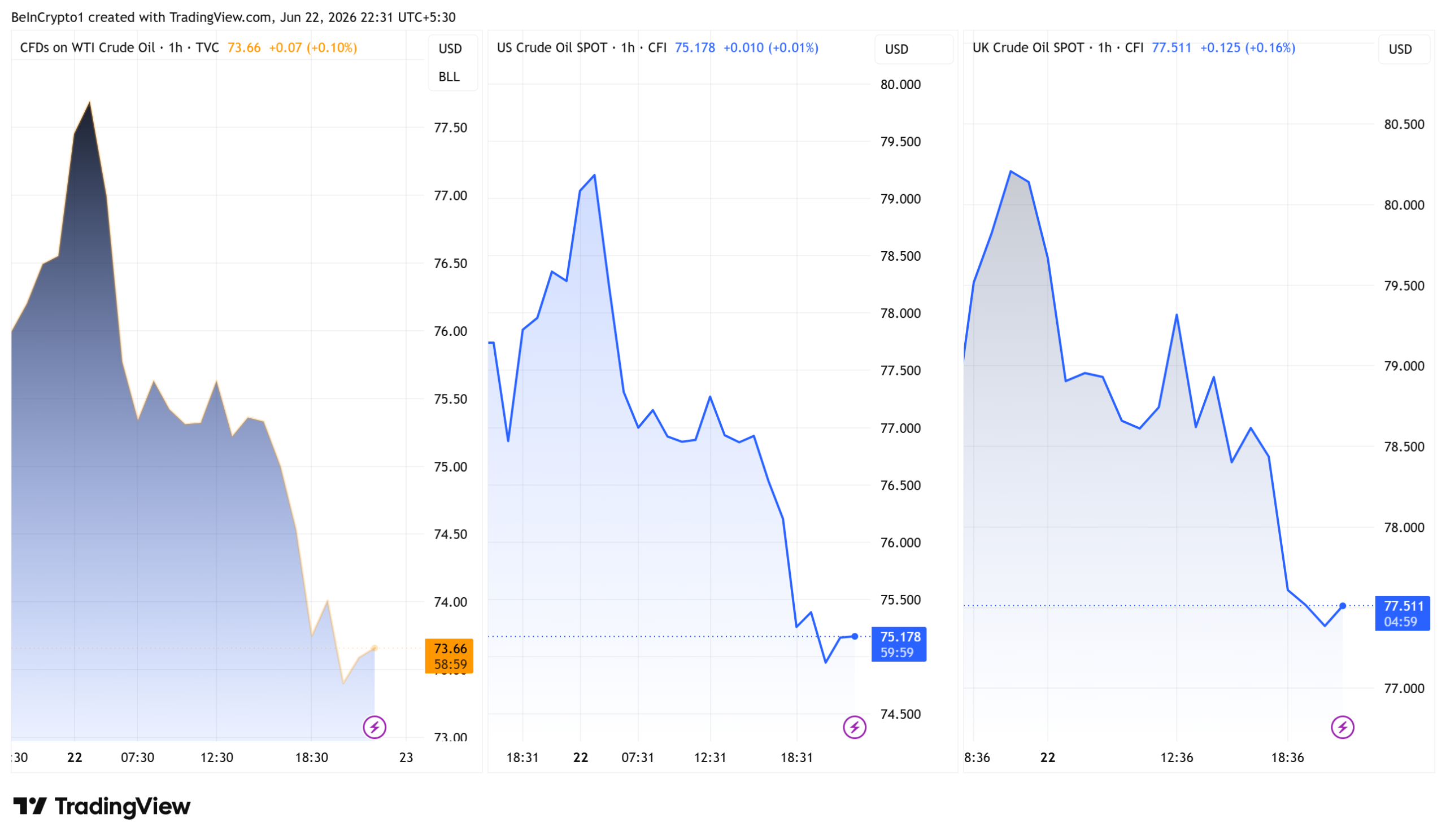

The US Treasury issued an oil license to Iran, allowing the production, sale, and delivery of Iranian crude for 60 days. Crude fell as traders priced in fresh barrels and a fading war premium. Iranian crude can reach mainstream buyers again for the first time since Washington reimposed sanctions in 2018.
The move ends four months of war that choked the Strait of Hormuz and sent oil prices sharply higher. For markets, the bigger question is what cheaper energy means for inflation and the global economy.
Crude Slips as the Iran Oil License Takes Effect
The Treasury license authorizes oil, petrochemical, and petroleum sales through August 21. An earlier license in March covered only cargoes already at sea, making this the widest opening in years.
Oil reacted fast. Brent fell more than 3% to about $77 a barrel, and West Texas Intermediate (WTI) dropped to near $74. The move extends oil’s month-long retreat on easing tensions.

The supply at stake is real. Before a US naval blockade in April, Iran exported over 1.5 million barrels a day. That fell to roughly 260,000 by May. Most feed Chinese refiners, and the lifted blockade lets them flow again.
The ramp-up will be gradual. Shipping, insurance, and buyer trust take time to rebuild. Still, the relief unwinds a first-quarter spike that drove Brent to $118 and stoked deeper supply-squeeze fears.
A Relief Valve for the Global Economy
Cheaper oil works like a tax cut for energy importers. The Strait of Hormuz carries about a fifth of the world’s oil, and most of it goes to Asia.
China, India, Japan, and South Korea spend less on fuel, freeing up household budgets and business costs.
Lower pump and heating prices act quickly to support consumer spending. Emerging market importers also gain room on energy bills and currencies.
Exporters feel the other side. Gulf producers and Russia earn less per barrel, while Iran regains a major revenue stream. OPEC+ may weigh output cuts to defend prices.
The clearest channel is inflation. US prices rose 4.2% in May, the highest in three years, with energy up 23.5%. The Federal Reserve held its rate at 3.50% to 3.75% on June 17.
Its new projections point to a hike, not a cut, this year.
That makes the oil license pivotal. Energy has driven the price surge, so cheaper crude is the fastest way to cool May’s inflation jump.
Markets now watch rate-cut odds and inflation expectations for a dovish turn.

Stocks Rotate as Inflation Bets Cool
Equities read de-escalation as risk-on. US stocks rallied to fresh records through June, with the S&P 500 briefly moving above 7,500 and the Dow topping 51,000.

Beneath the surface, leadership rotated. Energy shares lagged as oil majors fell with crude.
Airlines, shipping, and consumer names benefited from cheaper fuel.
Cyclicals and the Dow led, while rate-sensitive tech wobbled amid the Fed’s hawkish lean.
What it Means for Bitcoin and Risk Assets
Crypto sits at the crossroads. The Bitcoin (BTC) price traded near $64,499, after briefly reclaiming the $65,000 threshold on hype infused by JD Vance and MicroStrategy on Monday.
But it has slipped from $67,000 since the hawkish Fed meeting. Lower oil helps risk appetite, while higher-for-longer rates work against it.
The relief could prove brief. The license expires on August 21, and a failed deal would quickly restore the war premium.
Real export volumes and OPEC+ decisions will show whether it lasts. For now, cheaper oil softens the macro backdrop, even if the Fed has not.
The post Iran Oil License Sends Crude Lower: Will Inflation Follow? appeared first on BeInCrypto.
Markets,Editor’s Pick,Federal Reserve,Inflation News,Iran,Oil#Iran #Oil #License #Sends #Crude #Inflation #Follow1782154148