

Kalshi has added India to its list of restricted jurisdictions, preventing residents from accessing the U.S.-based prediction market platform, based on an updated members’ agreement published on Wednesday.
Summary
- Kalshi has added India to its list of restricted jurisdictions, preventing local residents from accessing the prediction market platform.
- The move follows India’s April advisory targeting prediction market websites and comes weeks after authorities blocked access to Polymarket.
- Sports and political prediction contracts continue to face regulatory scrutiny as multiple countries and U.S. states move against platforms such as Kalshi and Polymarket.
The revised document includes 55 restricted jurisdictions and now names India among the countries whose residents are barred from using the platform. The move comes nearly a month after Indian authorities blocked access to Polymarket and warned virtual private network providers against facilitating access to prediction market websites.
India expands restrictions on prediction markets
India’s Ministry of Electronics and Information Technology issued an advisory on April 25 directing internet service providers and VPN operators to prevent access to what it described as illegal and blocked online betting and prediction market platforms. Polymarket was among the platforms targeted under the order.
At the time, people familiar with the matter told local media that authorities could take similar action against Kalshi, although the platform remained accessible in India following the advisory.
Indian authorities have classified prediction market platforms under the Promotion and Regulation of Online Gaming Act 2025 as online money gaming services. Under the framework, platforms that allow users to stake real money on uncertain outcomes can fall within prohibited betting activity regardless of how operators describe their services.
Government officials have previously argued that event-based speculation platforms expose users to gambling-related harm and financial losses. Regulatory documents linked to the framework have also identified offshore prediction markets as high-risk services because some platforms support crypto payments and stablecoin settlement mechanisms.
The restriction on Kalshi follows broader scrutiny of crypto-linked and speculative financial platforms in India. Officials from the Ministry of Finance and the Reserve Bank of India have repeatedly discussed concerns about capital movement through stablecoins and decentralized financial services during policy deliberations tied to virtual digital assets.
Sports and political contracts face growing scrutiny
Regulatory pressure on prediction markets has increased in several countries and U.S. states, particularly around sports betting and political event contracts.
In May, authorities in Spain blocked access to both Kalshi and Polymarket after determining that the platforms did not comply with local gambling regulations. Indonesian authorities also restricted access to Polymarket after users traded contracts tied to whether President Prabowo Subianto would leave office before completing his term.
Singapore, Poland, Portugal, Hungary, Ukraine and Brazil have also restricted or prohibited access to prediction market services, including Kalshi and Polymarket.
Political prediction markets have drawn attention in the United States as well. In January, U.S. lawmakers introduced legislation that sought to limit political prediction market trading by government officials after a Polymarket user earned more than $400,000 on a contract tied to the potential removal of then Venezuelan President Nicolás Maduro. Lawmakers cited concerns about the possibility of insider information influencing trades.
Legal challenges have also expanded at the state level. Kentucky recently filed suit against five prediction market operators, including Kalshi and Polymarket. State authorities alleged that the companies were operating unlicensed sports betting and gambling platforms.
Kalshi and Polymarket remain the two largest prediction market platforms by trading activity. Defirate data shows Kalshi recorded $3.7 billion in weekly trading volume, while Polymarket processed $3.2 billion over the same period.
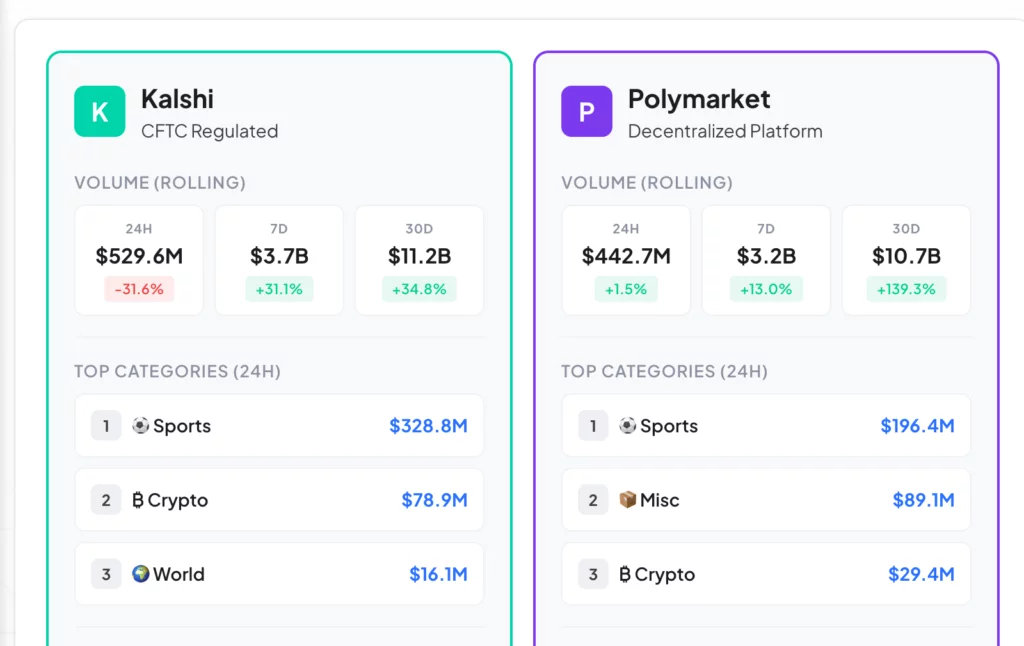
Source: Defirate.
Sports betting contracts accounted for the largest share of activity on both platforms. Defirate reported daily sports-related trading volume of $328 million on Kalshi and $196 million on Polymarket.
News,Polymarket,Prediction#Kalshi #restricts #Indian #users #regulatory #pressure #prediction #markets1782227398