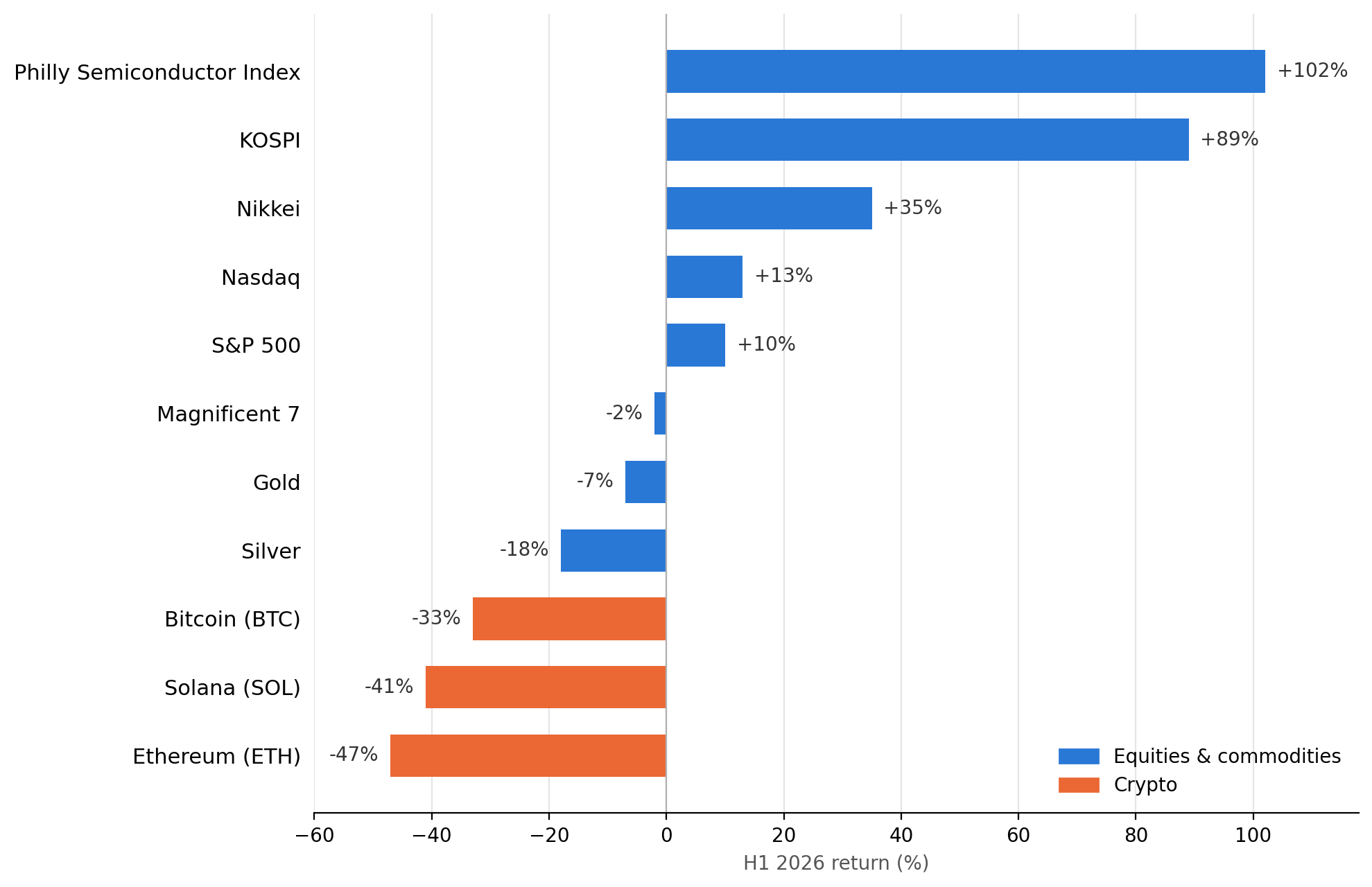

Semiconductor stocks beat both Big Tech and crypto in the first half of 2026. The Philadelphia Semiconductor Index gained 102%, while the Magnificent Seven fell 2% and Bitcoin (BTC) lost 33%, according to Deutsche Bank and CoinGecko data.
Wall Street banks now disagree about the second half. Goldman Sachs expects investors to keep backing chipmakers, while Morgan Stanley argues the trade has already started to unwind.
How Semiconductors Beat Big Tech and Crypto in H1 2026
Deutsche Bank’s half-year scoreboard ranked the Philadelphia Semiconductor Index as the best-performing major asset in the world. The benchmark gained 102% between January and June, according to a chart shared by Schaeffer’s Investment Research.
Korea’s chip-heavy KOSPI followed with an 89% gain, while Japan’s Nikkei added 35%. In contrast, the Nasdaq rose just 13% and the S&P 500 slightly under 10%.
The Magnificent Seven, the group that carried US markets for two years, ended the half 2% lower.

Crypto fared even worse. Bitcoin slid 33% in the first half, falling from roughly $87,500 to below $59,000, CoinGecko data shows. Ether (ETH) dropped 47%, and Solana (SOL) fell 41%. Traditional hedges offered no shelter either, as gold slipped 7% and silver lost 18%.
ETF flows tell the same story. The VanEck Semiconductor ETF climbed 72%, and the iShares Semiconductor ETF gained 99%, while the Roundhill Magnificent Seven ETF declined slightly.
Meanwhile, a shortage of memory and storage has led chipmakers to raise prices as the industry approaches $1 trillion in annual revenue.

Goldman Backs the Earners While Crypto Trades Like a Spender
Goldman Sachs derivatives specialist Brian Garrett explained the divergence in a client note last week, as reported by Stocktwits.
“One of the reasons for the decrease in Mag7 exposure seems almost too simple as it’s been hiding in plain sight for months. The market is rightly rewarding the names that earn (capex beneficiaries, semiconductors, etc) while at the same time questioning the names that spend (hyperscalers).”
Hyperscalers such as Microsoft, Amazon, Meta, and Google pour hundreds of billions of dollars into data centers. Markets increasingly treat that spending as a cost without a proven payoff.
Meanwhile, companies that sell chips, memory, and equipment recognize revenue today.
That logic hits crypto hardest. Bitcoin earns nothing from the AI buildout, so it traded alongside the spenders rather than the earners. The pressure intensified after Michael Burry’s bubble warning sent memory stocks sliding this month.
The same split appeared inside the crypto market. Render (RNDR) gained 17%, and NEAR Protocol (NEAR) added 18% in the first half, while most majors fell over 30%, per CoinGecko. Both tokens sell exposure to computing power, the scarcest resource of this cycle. However, the pattern is not universal, as Bittensor (TAO) and Fetch.ai (FET) still declined.

Bitcoin miners occupy the middle ground. Riot Platforms keeps selling BTC while funding its AI pivot, and rival miners chase similar data center deals.
Morgan Stanley Sees the Chip Trade Turning
Morgan Stanley strategist Michael Wilson argued on Monday that chip momentum is fading as investors rotate toward hyperscalers, Bloomberg reported. The Philadelphia index has dropped almost 14% from its June record, though it remains 123% higher since September.
Cracks appeared before July. A blowout Micron forecast failed to sustain the rally, and the KOSPI triggered circuit breakers in June. Wilson, therefore, favors hyperscalers in the near term and expects them to soften spending plans.
JPMorgan strategist Mislav Matejka believes the rally will broaden beyond technology in the second half.
“AI is unlikely to be the only story in town.”
For crypto, this debate matters more than it appears. If capital exits the crowded chip trade and hunts laggards, Bitcoin ranks among the largest liquid laggards available. The token trades near $61,626 after a weekend short squeeze briefly lifted it toward $64,000.
Still, no major bank has named digital assets as the next rotation target. The coming weeks will show whether hyperscaler earnings confirm the turn, and whether any freed capital finds its way back to crypto.
The post Semiconductors Beat Big Tech and Crypto in H1: Is the Trade Turning? appeared first on BeInCrypto.
Stocks,AI News,Bitcoin (BTC) News,Stock Market News#Semiconductors #Beat #Big #Tech #Crypto #Trade #Turning1783386825