
Europe entered a new phase of crypto regulation on July 1, 2026, when the final transitional period under the Markets in Crypto-Assets Regulation expired. Crypto-asset service providers operating under earlier national regimes had until this date to obtain MiCA authorisation or begin ending their EU activities.
The deadline has reduced the number of providers able to serve the region, strengthened the commercial value of an EU licence, and raised new questions about product access, passporting, and consistent enforcement across member states.
BeInCrypto interviewed Philipp Bohrn, vice president of group governance at Bitpanda, Mike Schwitalla, chief commercial officer at Crypto Finance Group, and Chagri Poyraz, chief strategy officer at OSL Group, about how MiCA is changing Europe’s crypto market.
MiCA is now changing which companies can reach European users, which assets appear on their platforms and how regulated providers describe the protection attached to their services.
Europe’s Crypto Market Splits Along Regulatory Lines
MiCA became fully applicable in December 2024, although existing companies could continue operating under national transitional arrangements. Those arrangements lasted until July 1, 2026 at the latest, or ended earlier when a company received or was refused authorisation.
European users may now need to confirm whether a familiar exchange, broker or custodian appears in ESMA’s register. Some providers have transferred clients to authorised European entities, while others have restricted account functions or withdrawn from the region.
Mike Schwitalla, chief commercial officer at Crypto Finance Group, described the deadline as the point at which the distinction between regulated and unauthorised providers became visible to users.
“Many retail investors may only now be realizing that some platforms they have used for years might not be authorized to continue operating in the European market,” Schwitalla said. “As a result, users are increasingly assessing the regulatory status of their providers and, in some cases, whether they need to migrate assets to licensed institutions.”
The decline in provider numbers may concentrate activity among companies able to meet the requirements and absorb customers leaving unauthorised platforms.
It could also strengthen relationships between licensed crypto companies and banks, asset managers or corporate counterparties whose internal policies require regulated service providers.
Philipp Bohrn, vice-president of group governance at Bitpanda, said the absence of authorisation after the extended preparation period gives users relevant information about a company’s regulatory standing.
“It is now becoming clearer which companies are authorised, supervised and accountable in Europe, and which are operating outside that framework,” Bohrn said.
Authorisation creates accountability around the provider, although it leaves the financial risks of crypto assets intact. European supervisory authorities continue to warn consumers that protections vary according to the product and service involved.

One Regulation Creates Different Tests Across the Industry
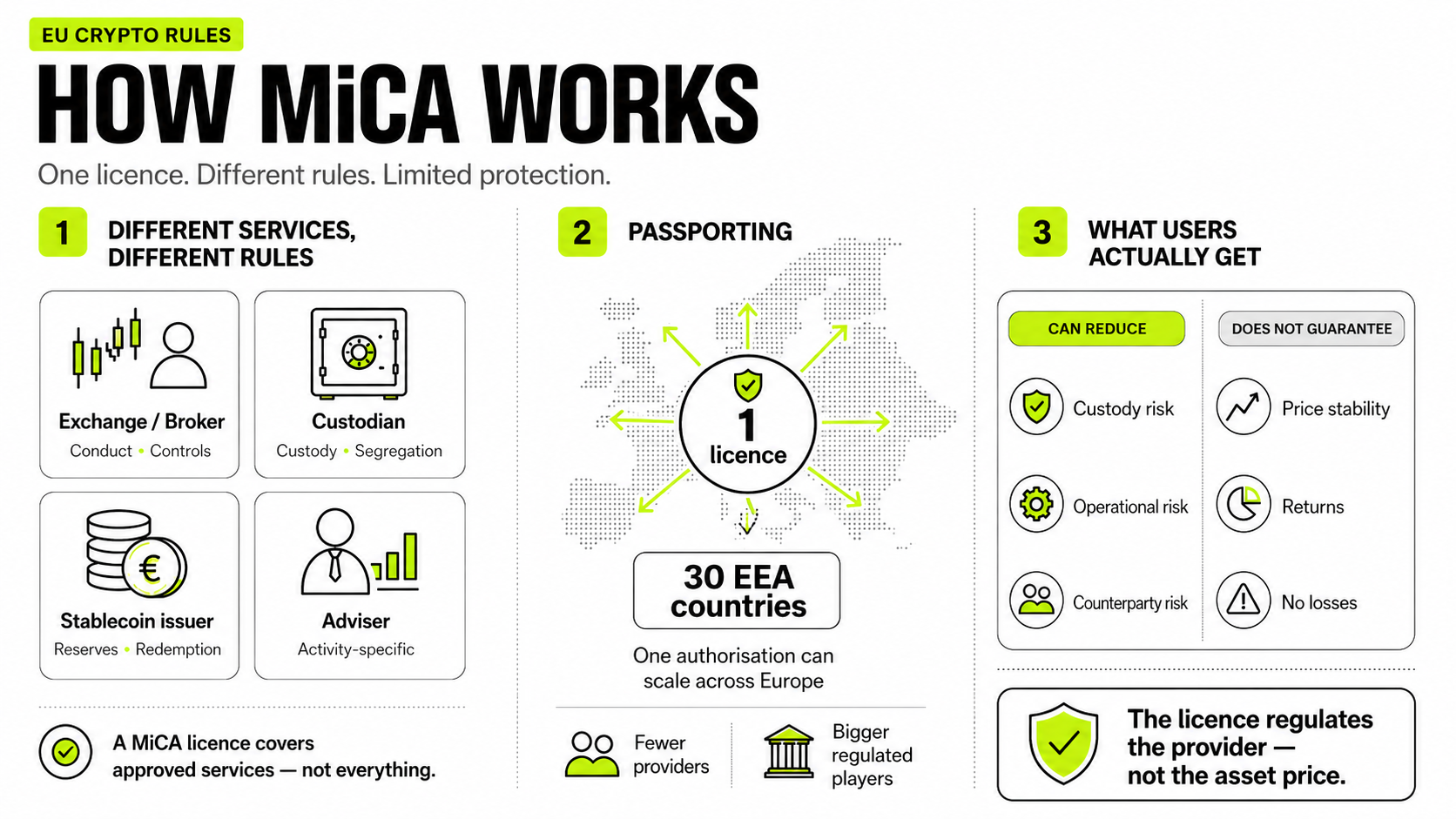
MiCA covers several types of crypto businesses, yet the obligations depend on the services each company provides.
Trading platforms and brokers face requirements involving governance, market conduct, client information, and operational controls.
Custodians must maintain custody policies and agreements with clients, while applicants holding customer assets must describe how those assets and funds will be segregated.
Stablecoin issuers operate under a separate set of requirements covering reserves, disclosures, redemption, and supervision. The European Banking Authority also assesses whether asset-referenced tokens and electronic money tokens qualify as significant, which can bring additional oversight.
Advisers, order executors and portfolio managers encounter obligations linked to their own activities. A single MiCA licence therefore represents authorisation for specified services rather than a universal approval covering every product offered by a company.
“A broker, an exchange, a custodian, a stablecoin issuer and an advisory provider do not all face the same obligations,” Bohrn said. “For established European players that have already invested in governance, compliance, custody standards and risk management, MiCA is demanding but also a natural next step.”
The difference is especially important for global companies accustomed to serving several European countries through national registrations or cross-border access. MiCA requires an authorised European entity with effective management and a genuine presence in an EU member state.
Banks encounter a different calculation. Rather than obtaining every technical and regulatory capability internally, they can work with authorised custodians, brokers and trading providers whose systems have already undergone supervisory review.
Schwitalla said this changes the point from which financial institutions can begin developing digital-asset products.
“A bank looking to offer digital asset services does not need to build every capability from scratch,” he said. “It can work with an already regulated and proven provider that has met the requirements of one of the world’s most comprehensive crypto regulatory frameworks.”
Passporting Rewards Licensed Firms as Product Choice Contracts
A MiCA authorisation obtained in one member state can be passported across the EU, allowing a provider to offer approved services without seeking a separate licence in every national market.
This arrangement gives licensed firms access to a large regional customer base through one authorisation process. It may also reduce the regulatory burden for banks and other institutions seeking partners across several European countries.
Chagri Poyraz, chief strategy officer at OSL Group, said the combination of passporting and a reduced pool of authorised competitors gives licensed firms a significant commercial advantage.
“A single authorization now passports across all 30 EEA countries, which means licensed firms get a genuinely borderless European market, stronger banking relationships, and enterprise counterparties who will only work with fully regulated entities,” Poyraz said.
Users may experience the same process as a reduction in access. Companies may withdraw from Europe rather than complete authorisation, while regulated platforms may remove assets or services that create additional compliance concerns.
Stablecoin markets have already shown how European rules can change product availability. Several exchanges restricted or removed trading pairs involving stablecoins whose issuers had yet to meet applicable MiCA requirements.
A July 2026 study found that MiCA-related delistings reduced USDT trading on exchanges with greater European exposure and increased USDC’s relative share on those venues.
Some lending, staking, and decentralised finance products remain outside MiCA or fall under other regulatory assessments. The licence held by a provider, therefore, cannot be treated as approval of every service displayed beside its regulated offering.
ESMA has warned about this “halo effect,” under which customers may assume products offered by an authorised company receive equivalent regulatory treatment.
A MiCA Licence Protects the Service, Not the Asset Price
The distinction between provider supervision and investment protection will become increasingly important as companies market their authorisations.
MiCA introduces standards covering governance, complaints, conflicts of interest, disclosures and custody. It also gives authorities powers to supervise providers and intervene where crypto products create significant investor-protection or market-integrity concerns.
These requirements can reduce operational and counterparty risks, although they cannot prevent token prices from falling, guarantee returns or place every crypto asset within a compensation scheme.
“MiCA authorisation is not a guarantee that prices will be stable, or that users cannot lose money,” Bohrn said. “It means the provider has met regulatory standards around how it operates.”
Companies will need to distinguish between regulated services, products governed by separate EU legislation and activities outside the current framework. The explanation becomes especially relevant when one application contains custody, spot trading, derivatives and lending products carrying different legal treatment.
Schwitalla said providers should describe compliance through the controls applied to the company rather than presenting authorisation as protection from investment losses.
“A regulated provider can reduce operational, custody and counterparty risks, but it cannot remove market risk,” he said. “The industry has a responsibility to avoid creating a false impression that regulatory approval is equivalent to a guarantee of returns or protection from losses.”
Enforcement Will Decide Whether MiCA Creates One European Market
MiCA’s common rules still depend largely on national authorities responsible for authorising and supervising providers.
This division has already raised concerns about differences in licensing standards. France’s markets regulator warned in May that companies operating without authorisation could face blacklisting or prosecution, while also questioning whether applications were receiving equivalent scrutiny across member states.
Passporting works effectively when regulators trust authorisations issued elsewhere in the bloc. Major differences in application reviews or ongoing supervision could recreate fragmentation through enforcement, even where the underlying law remains common.
“The most interesting issue is enforcement and passporting in practice,” Bohrn said. “If implementation becomes fragmented, Europe will have created a common rulebook without a truly common market.”
Enforcement will also reveal the difference between policies written during an application and controls operating under everyday market conditions. Transaction monitoring, governance and risk systems require continuous adjustment as companies add products and process higher volumes.
“A licence names the controls – it doesn’t prove they work,” Poyraz said. “Watching enforcement separate those two groups over the next few quarters will tell us far more about where this market is heading than any single new rule will.”
ESMA has begun building the mechanisms needed for this phase. Its central registers cover authorised providers, crypto-asset white papers and entities identified as non-compliant, while national authorities retain responsibility for most company-level supervision.
Future revisions commonly described as MiCA 2.0 may address areas such as decentralised finance, lending and other activities left partly outside the first regulation. The immediate concern remains the operation of the current framework across national borders.
MiCA has already reduced the number of companies able to serve European crypto users. Its longer-term impact will depend on whether passporting produces a genuine single market, whether supervision remains consistent and whether users understand the limits attached to regulatory authorisation.
Europe has completed the licensing stage. The conduct of authorised firms and the response to those operating outside the rules will now determine the quality of the market that remains.
The post MiCA is Turning Europe Into a Licensing Test for Every Type of Crypto Company appeared first on BeInCrypto.
Regulation,Editor’s Pick,EU Regulation,MiCA News#MiCA #Turning #Europe #Licensing #Test #Type #Crypto #Company1784891434