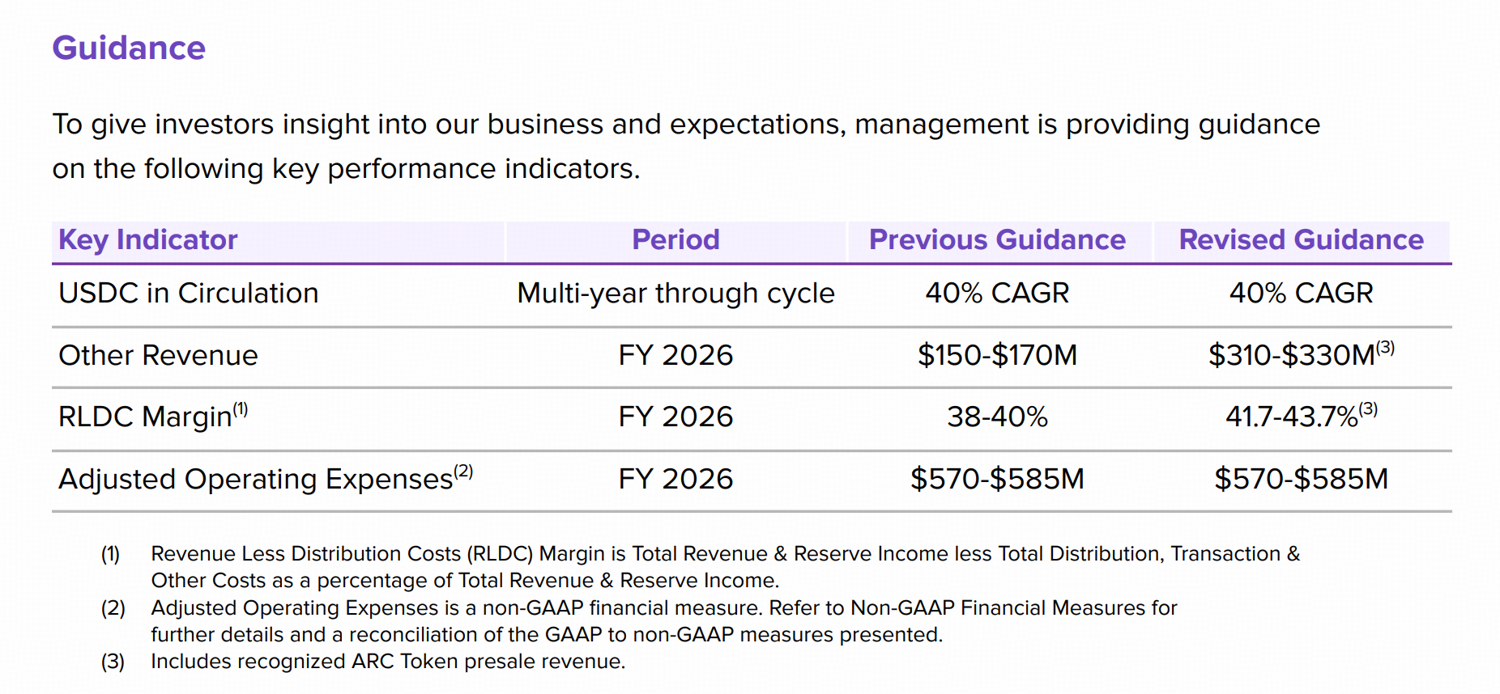

In its Q2 earnings release, management raised guidance for both other revenue and RLDC margin, which surprised us. A closer look shows that the increase is driven by one-time Arc token presale revenue. This buys Circle time through the 2026 crypto bear market. If the crypto cycle bottoms in Q4 and on-chain activity recovers next year, USDC will be well positioned for the next crypto bull market.
- Q2 results were stable, while the increase in FY2026 guidance was driven primarily by Arc token presale revenue.
- Interest-rate and distribution-cost risks appear contained through year-end, while USDC circulation remains under pressure from the current crypto bear market.
- USDC is well positioned to benefit from the next recovery in crypto activity. Its concentration in trading, collateral, and DeFi makes circulation highly pro-cyclical and particularly responsive to a rebound in on-chain liquidity.
Circle reported $701 million in total revenue and reserve income, while adjusted EBITDA rose 8% year over year to $143 million. The more significant update came from guidance: FY2026 other revenue was raised to $310–330 million from $150–170 million, and the revenue less distribution costs (RLDC) margin outlook increased to 41.7–43.7% from 38–40%. The revisions point to stronger non-reserve monetization and better operating leverage than previously expected.

Source: Circle
Arc will be a new engin, but the first fuel is a token presale
Arc is Circle’s own Layer-1 blockchain, a settlement network purpose-built for stablecoin finance with USDC as the native gas token. It moves Circle up the stack, from issuing a token that lives on other chains to operating the chain itself, where it can capture block space gas revenue rather than reserve yield alone. Gas is the fee users pay to transact on a blockchain; today those fees flow to the networks that host USDC, such as Ethereum and Solana, while on Arc USDC is the gas asset and Circle collects them. Circle expects these economics to be shared with validators and other network participants, giving it direct exposure to Arc activity without capturing every transaction fee.
Arc’s public mainnet is scheduled for September 16 with institutional validators including BlackRock and DTCC. DTCC plans to enable the tokenization of DTC-custodied assets on Arc, while BlackRock expects to deploy BUIDL with native USDC integration. These commitments give Arc credible launch distribution and clear institutional use cases across tokenized securities, collateral, and settlement.
The near-term number, though, comes from selling the token. Ahead of mainnet Circle ran an Arc token presale, placing the network’s native token with investors before launch, and roughly $180 million of the other revenue guidance raise is that presale revenue.
The token sale lifted 2026 other revenue and margin. Recurring Arc economics, staking, transaction fees, and commercial services generated by actual network usage, arrive after launch and remain dependent on adoption.
Rate and distribution risk have turned gentler
Circle’s earnings are driven by three variables: USDC circulation, the yield earned on reserve assets, and the share of that yield retained after distribution costs. For every USDC in circulation, Circle holds an equivalent amount of cash and short-duration U.S. Treasuries, with reserve income generated from the yield on those assets.
The reserve return rate was 3.48% in Q2, down with SOFR, and reserve income remains the core of the business. Rates are not expected to fall materially in the near term, so the yield on Circle’s reserves holds up. And the distribution cost that eats into that yield just cleared its biggest question: the Coinbase agreement renewed on existing terms, removing the scenario where Circle’s largest partner extracts a larger cut.
Management’s guidance reinforces that stability. Excluding the Arc token presale contribution, full-year revenue less distribution costs, or RLDC, margin is expected to land around the midpoint of the previous 38–40% range, implying roughly 39%. With reserve yields holding up and distribution economics risk moderated, near-term earnings growth increasingly depends on a recovery in USDC supply.
Falling USDC Circulating Supply

Source: Defillama
USDC Supply Remains Under Pressure Amid Weak On-Chain Activity, With Strong Recovery Potential as the Crypto Cycle Turns
Circle’s long-term base case assumes a 40% compound annual growth rate in USDC circulation. Circulation is currently contracting. The investment debate therefore hinges on whether emerging USDC-native use cases can scale fast enough to overcome the cyclical decline in broader on-chain activity.
USDC and USDT increasingly serve different functions within the on-chain dollar market. At the end of June, USDT supply was roughly split between Tron and Ethereum at $89.9 billion and $86.7 billion, respectively. USDC was more concentrated on Ethereum at $47.4 billion, followed by Solana at $7.8 billion, HyperEVM at $5.4 billion, and Base at $4.2 billion. This distribution reflects a broader difference in how the two stablecoins are used.
USDT Supply by Chain

Source: Defillama
USDC Supply by Chain

Source: Defillama
USDT acts primarily as a payment and transfer rail. On Tron, approximately 93% of USDT sits in ordinary wallets, while 79% of transfers are simple token movements with limited interaction with DeFi protocols. During the first half of 2026, USDT settled about $95 billion of identified commerce and payment volume, compared with $14 billion for USDC, and represented approximately 92% of the $48 billion in identified B2B payments. These patterns are consistent with USDT’s role in remittances, peer-to-peer transfers, offshore exchange settlement, and cross-border commerce.
USDC functions more like a trading, collateral, and settlement asset. In June alone, USDC generated approximately $2.6 trillion of transfer volume on Base and $1.6 trillion on Ethereum. USDC on Base turned over as much as 20 times per day, with activity dominated by DEX liquidity and flash loans. The same pattern appears on HyperEVM, where USDC supply rose to $5.4 billion after becoming the principal stablecoin supporting Hyperliquid’s trading ecosystem.
This specialization makes USDC more sensitive to crypto-native risk appetite than USDT. That sensitivity is currently a headwind: the market remains in a deep bear phase, liquidity has contracted, and on-chain trading activity has fallen sharply from cycle highs. Crypto markets have historically followed pronounced boom-and-bust cycles, and the current downturn could approach a durable bottom in Q4 if previous cycle patterns remain relevant. Until then, weaker risk appetite is likely to keep pressure on USDC circulation.
Total Value Locked in DeFi also follows Crypto bull-bust cycle

Even within the downturn, several areas of on-chain activity continue to expand. Perpetual DEXs are among the strongest. The category has become a core venue for leveraged trading, with USDC widely used as collateral, margin, and settlement liquidity. Hyperliquid is the largest example, processing roughly $200 billion in trailing 30-day perpetual volume, but the broader significance lies in the growth of decentralized derivatives as a sector. As perp DEXs gain liquidity, users, and market share, they create recurring demand for USDC balances across trading accounts, liquidity pools, and market-making strategies.
Prediction markets provide a second source of structural demand. Polymarket uses pUSD, a fully USDC-backed collateral asset, and processed approximately $3 billion in trading volume over the latest 30-day period.
USDC is therefore well positioned for the next recovery in crypto activity. Its concentration in trading, collateral, DeFi, and settlement makes circulation highly pro-cyclical: supply contracts when on-chain liquidity falls, but it can reaccelerate rapidly when trading volumes, leverage, and capital return.
Disclaimer: The information provided herein does not constitute investment advice, financial advice, trading advice, or any other sort of advice, and should not be treated as such. All content set out below is for informational purposes only.
The post BloFin Research: Circle’s Q2, Arc Token Presale Lifts Guidance and Bridges the Crypto Downturn appeared first on BeInCrypto.
Businesses,Editor’s Pick#BloFin #Research #Circles #Arc #Token #Presale #Lifts #Guidance #Bridges #Crypto #Downturn1786631292