
A new mystery shopping study from the Bank of Italy, Italy’s central bank, found stablecoins offer no systematic cost advantage over traditional remittance channels.
The Bank of Italy sent 200 USD Coin (USDC) across ten real-world corridors. The routes linked Italy with Argentina, Brazil, South Africa, the United Arab Emirates, and Japan.
Fiat Conversion, Not Blockchain, Drives Costs
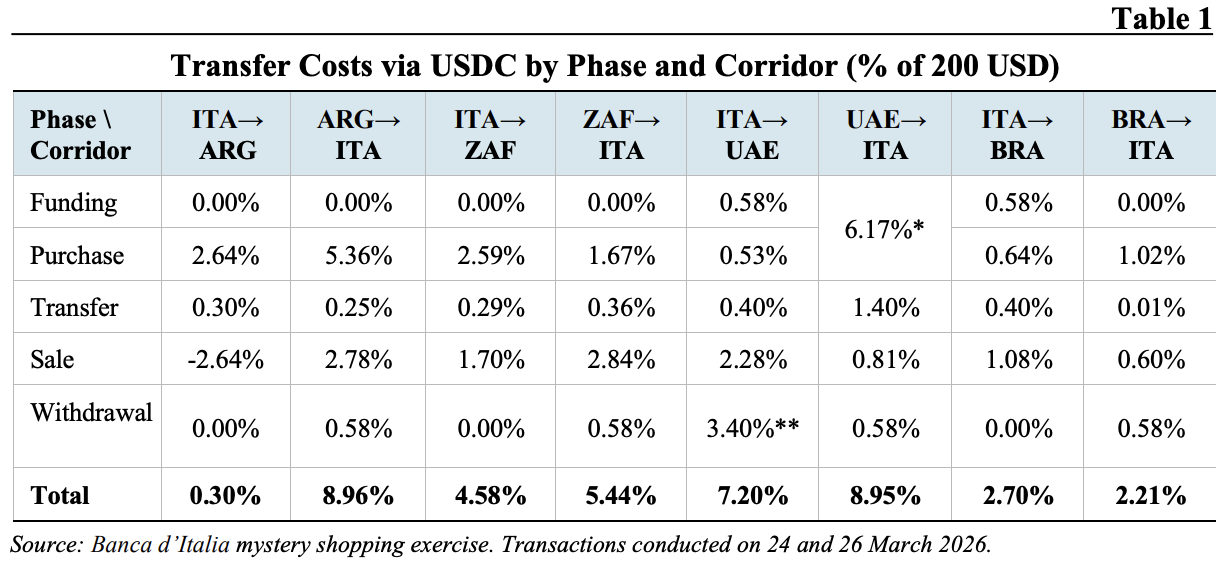
Total transfer costs ranged from 0.3% to nearly 9% of the amount sent, the study found. That range straddles the United Nations’ target of cutting remittance costs below 3% by 2030.
Researchers tracked five phases of each transfer, from funding an exchange account to withdrawing cash at the destination. The on-chain blockchain transfer itself averaged just 0.4% of total cost.

Funding, currency conversion, and withdrawal drove almost all of the expense instead. Those are the steps that still run through banks and exchanges rather than the blockchain.
A United Arab Emirates to Italy transfer illustrates the problem. The sender had no bank transfer option and had to fund the trade with a credit card instead. That card carried a 3.8% surcharge, which pushed the total cost to nearly 9%.
The World Bank puts the global average remittance cost at 6.4%, well above the UN’s 3% target. Against the World Bank’s country-specific benchmarks, however, stablecoins beat traditional costs in every corridor the study tested except the UAE.
The Bank of Italy also compared USDC against Wise, a money transfer operator, on the same routes. Stablecoins came out cheaper on three corridors and more expensive on four others, undercutting any claim of a consistent edge.
Domestic Payment Rails Determine Speed
Execution times varied just as widely as costs. Transfers settled in under 20 minutes wherever instant payment systems existed. Brazil’s Pix network and the euro area’s TARGET Instant Payment Settlement (TIPS) service both qualified.
South Africa lacked that kind of infrastructure. A stablecoin transfer there took one to two business days, the same timeline as a conventional bank wire.
The findings complicate a narrative that stablecoins are already quietly replacing bank payment rails. The Bank of Italy’s researchers argue the technology still relies on the banks it aims to bypass.
The study also reviewed global stablecoin rules. It named Europe’s Markets in Crypto-Assets Regulation (MiCA), the bloc’s framework for crypto-asset issuers, among the more comprehensive regimes.
A related review of Europe’s post-MiCA crypto market found Circle remains the dominant compliant stablecoin issuer.
Strict regulation carried its own cost, though. The Bank of Italy found that Japan’s rules pushed users toward unregulated wallets rather than curbing demand. Whether looser on-ramp rules could close that gap remains an open question for policymakers.
The post Bank of Italy Study Finds Stablecoins No Cheaper Than Traditional Remittances appeared first on BeInCrypto.
Technology,Editor’s Pick,Stablecoin News#Bank #Italy #Study #Finds #Stablecoins #Cheaper #Traditional #Remittances1787107517