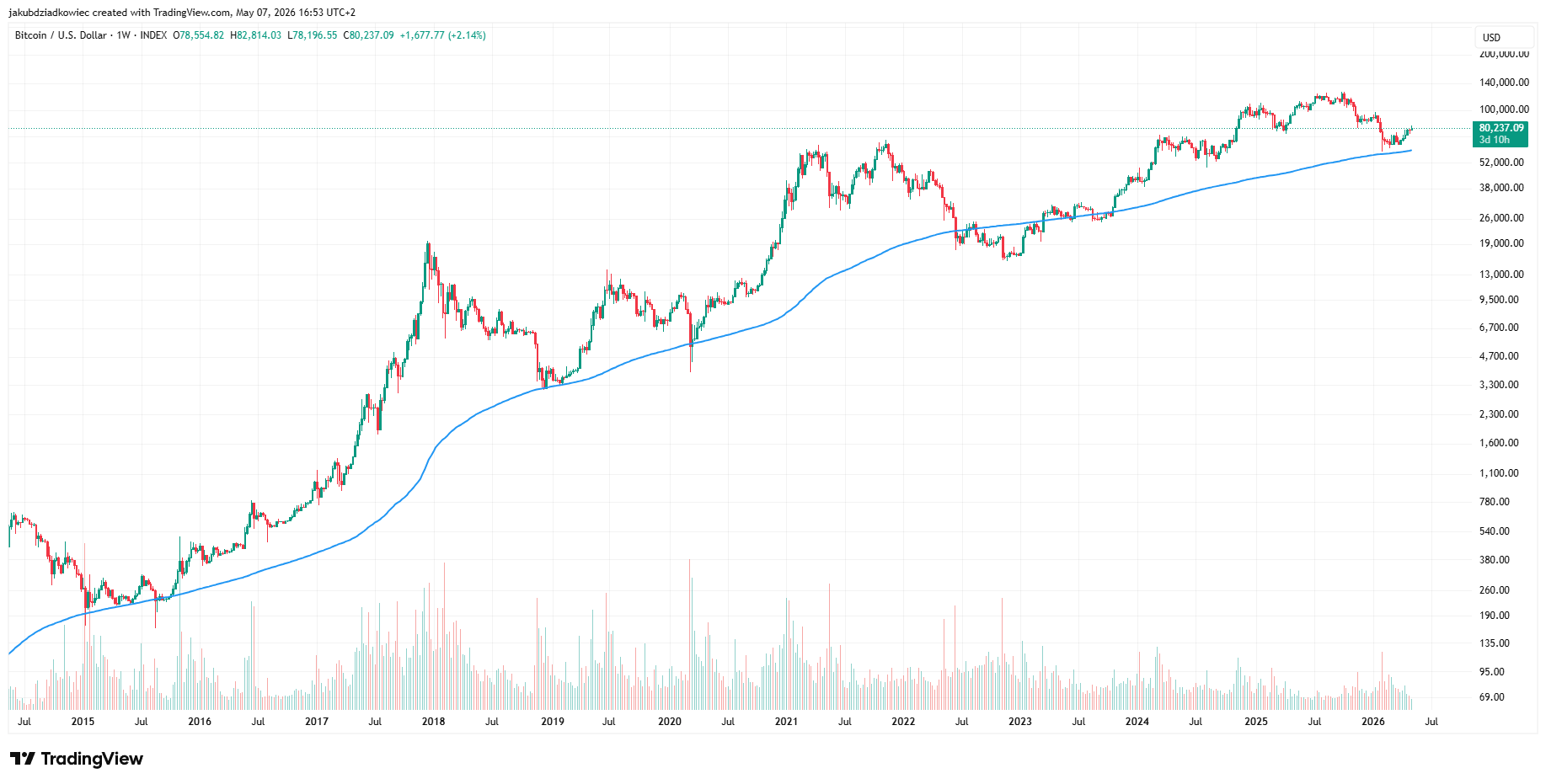

Bitcoin’s on-chain metrics have hit deep-value readings normally seen at cycle bottoms, even though price has only retraced about 40% from its all-time high. That drawdown sits far below the 75% to 85% declines that defined prior bear cycles.
Six widely tracked indicators now point in the same direction. They describe a market that reset without a euphoric top while long-term holders refused to distribute.

Bitcoin Cycle: Capitulation Without a Collapse
Three indicators measure stress in the price-versus-trend relationship, and all three agree.
The Mayer Multiple Z-Score compares Bitcoin’s (BTC) price to its 200-day moving average. The metric recently dropped to roughly -1.5 standard deviations. That zone has been printed only twice before in recent history.
The first instance came in March 2020, for around $3,000. The second arrived during the FTX collapse in late 2022, around $19,000. The current tag occurred at roughly $62,000. BTC has since recovered toward $80,000.

The Bitcoin Sharpe Ratio also confirms this condition. The metric has dropped into its “Low Risk” band. That territory previously defined the 2015, 2019, and 2022 cycle lows.
Each prior tag preceded a major upward leg, although the sample size remains small.
The percentage of supply held in loss has also climbed near 39%, per In The Cryptoverse data. That level historically appeared during the late stages of bear markets, not while the price held in six figures. The divergence between price level and holder pain stands out as the cycle’s defining anomaly.

Bitcoin’s 200-week moving average adds a fourth confirmation. The line has acted as the floor of every prior cycle. It broke briefly in 2018 and was wicked below in 2020 and 2022. This time, the 200WMA tagged and held without a clean violation.
A Bitcoin Cycle With No Top
The capitulation signals are striking in part because they lack a normal counterpart, the euphoric top.
The CBBI Bitcoin Bull Run Index combines multiple cycle metrics. The composite never tagged its red zone above 80 during this run. Every previous bull cycle, including 2013, 2017, and 2021, hit that threshold cleanly. The current chart explicitly marks the missed signal with an X.

Glassnode’s Net Unrealized Profit and Loss (NUPL) data tells a similar story. The metric uses color-coded zones that run from blue euphoria to red capitulation. The 2024 to 2026 expansion topped out in the green “belief” zone without ever crossing into blue.
By that measure, the market never reached the mass-greed reading that historically defined a cycle high. NUPL has since rolled lower into orange territory, the band associated with mid-bear or pre-bottom positioning.
That trajectory mirrors the path NUPL traced in 2018 and 2022, although the underlying price action differs sharply.

The Cohort That Refused to Sell
The most unusual signal sits in long-term holder behavior.
Glassnode defines long-term holders (LTH) as wallets that have held coins for at least 155 days. In every prior cycle, this cohort distributed heavily into the top. The LTH supply curve dropped as new buyers absorbed the available coins. That pattern repeated cleanly in 2014, 2018, and 2021.

This cycle broke that pattern. LTH supply dipped slightly in 2024, but it has since returned to record levels above 14.5 million BTC. Long-term holders now sit near peak conviction with price still well above the 200-week moving average.
The behavior carries two possible readings. The bullish interpretation suggests long-term holders are waiting for a higher peak that has yet to arrive. The structural interpretation points to a different LTH composition. The cohort now includes ETF cold storage, sovereign reserves, and corporate treasuries with non-cyclical mandates.
Both readings support the broken-cycle thesis. Neither one alone explains a continued bear case from current levels.
An Asymmetric Setup
The combined picture across six on-chain charts presents an unusual triangulation. Capitulation-grade readings appear in three price-derived metrics.
No euphoria appears in two sentiment-derived metrics. No distribution appears in the cohort that historically defines the top.
Markets rarely show all three conditions at once.
The simplest version of the thesis suggests Bitcoin just absorbed a deep on-chain reset without holding a euphoric top. Meanwhile, the holders most likely to sell have refused.
Historically, that combination has resolved to the upside.
A counterargument deserves space. If the four-year cycle model is genuinely broken, the same logic should apply to the prior cycle bottom signals.
The Mayer Z, Sharpe Ratio, and capitulation reads work as buy zones because they reflect a recurring market psychology. A structurally different cycle could mean those signals carry less predictive weight than past performance suggests.
For long-term observers, the on-chain picture nonetheless skews asymmetric. Price sits well below the cycle high yet remains above the 200-week moving average.
The Holder conviction remains intact, and historically rare buy signals have aligned. Whether the cycle delivers another leg up or settles into a longer consolidation, the current data set stands out. It is the most coherent on-chain bottom signal Bitcoin has produced in years.
The post Bitcoin Cycle Breaks Pattern as On-Chain Metrics Hit 4-Year Low appeared first on BeInCrypto.
Markets,Bitcoin (BTC) Analysis,Bitcoin (BTC) Bull Market News,Bitcoin (BTC) News,On-chain Analysis#Bitcoin #Cycle #Breaks #Pattern #OnChain #Metrics #Hit #4Year1778196745