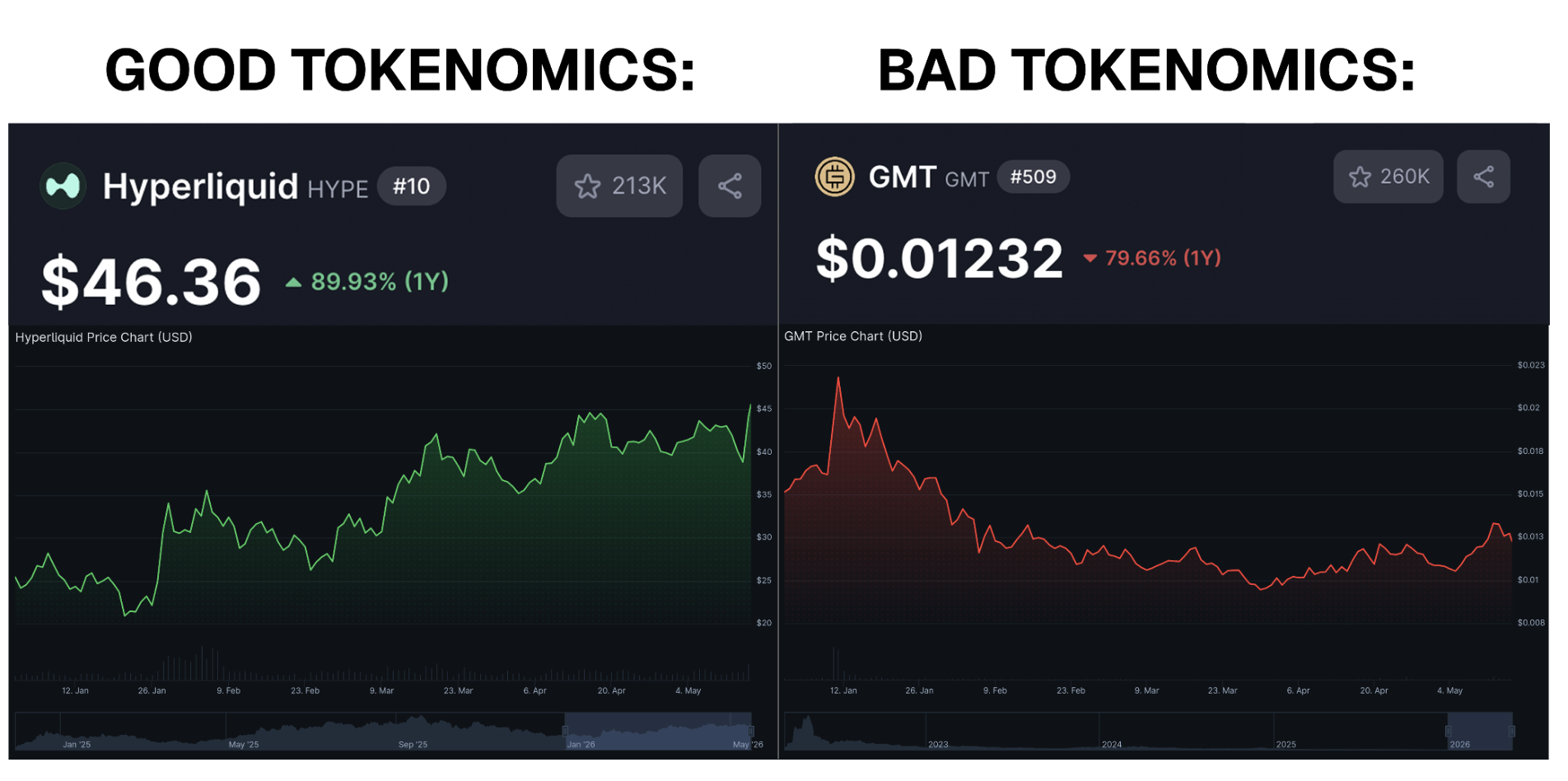

When a crypto project publishes its tokenomics, the first thing people often see is a supply chart.
A typical announcement gives 25% of tokens to the team, 30% to validators, another share to the community, and a separate allocation for a possible airdrop. Influencer channels repost those numbers, add the vesting schedule, and present the project’s economy as a simple allocation table.
Many early-stage founders learn tokenomics through these posts. They begin to see it as a breakdown of who receives tokens and when those tokens unlock.
Real tokenomics goes far deeper, defining the economic value behind the token. It explains:
- Why the token exists;
- How it creates value;
- Who needs it;
- How users earn with it;
- How investors exit;
- How demand may develop after launch.
According to 8Blocks, founders often confuse token supply design with tokenomics itself. A supply table has value, but it represents one part of a much larger economic document.

Tokenomics Has Become a Full Economic Model
In the early years of crypto fundraising, tokenomics was often simple. A project could publish a token distribution chart, add vesting terms, describe basic utility, and move toward a token sale.
The market has matured. Investors, users, exchanges, and ecosystem partners now expect a deeper explanation of how the token functions inside the project.
Modern tokenomics can cover token utility, earning mechanics, governance rights, emissions, balancing mechanisms, incentives, treasury usage, distribution logic, and secondary market behavior.
Ultimately, the purpose of tokenomics is to explain why the token needs to exist.
Every section should help answer it. If the token provides access to a product, the model needs to explain how access works. If users earn through participation, the model should define where rewards come from. If holders gain influence over the project, governance needs real procedures and a connection to project operations.
Percentages explain ownership. They say little about demand, incentives, behavior, or long-term survival.
Founders Need Tokenomics Before Launch
Detailed tokenomics helps founders understand the product they are taking to market.
Many token projects begin with a product idea and add the token near the end as a fundraising, community, or growth tool. This can create confusion inside the team. Product, legal, marketing, business development, investors, and community managers may all describe the token in different ways.
A proper tokenomics document gives the project one shared economic logic. Everyone involved should understand what the token does, who needs it, why demand may appear, how supply enters circulation, and how the project plans to manage the post-launch period.
Weak tokenomics leaves too much room for assumption. Consultants may give founders incomplete guidance. Internal teams may expect one outcome while the actual mechanics produce another. Marketing may promise benefits the economic model cannot support.
The problem usually appears after TGE. Users receive the token and ask why they should hold it. Investors look for exit conditions. Market makers face unclear demand. The team starts making decisions under pressure.
At this stage, tokenomics becomes repair work instead of economic design.
Investors Use Tokenomics for Fundamental Analysis
For investors, tokenomics is one of the strongest tools for evaluating a project before buying or funding it.
A serious investor needs more than a supply chart. They need to understand unlock pressure, expected demand, project revenue, user incentives, treasury strategy, governance rights, and possible exit paths. They also need to see whether the token has a real function inside the project or mainly serves as a fundraising asset.
Detailed tokenomics helps investors assess risk. They can estimate how much supply may enter the market, when pressure may appear, which groups may sell, and whether future demand has a real source.
A vesting schedule shows when tokens unlock. It does less to explain who may buy them, why users may keep using them, or how the project plans to support its economy during weaker market periods.
This is why tokenomics often separates serious projects from short-lived launches. A strong document gives investors enough information to judge whether the team has thought through its own economy.
Secondary Market Performance Starts Before TGE
The most important test for tokenomics begins after launch.
A project may attract attention, secure listings, complete an airdrop, and create early momentum. Once the token starts trading freely, the market tests whether real demand exists beyond the launch phase.
If the model focuses mainly on distribution, the answer is usually weak. Team, investor, ecosystem, and community allocations may all be defined, while post-launch demand remains unclear. The model explains how tokens enter circulation, yet gives little detail on why users, partners, or market participants may want to acquire them later.
A stronger tokenomics model studies secondary circulation before TGE. It considers buybacks, revenue sources, reward balance, utility demand, and token sinks. These mechanisms help reduce unnecessary sell pressure and give the token a reason to stay active after the first wave of attention.
This forces founders to connect the token to real business logic. A project with weak revenue, vague utility, and limited user demand will struggle once launch excitement fades.
Many tokens with thin tokenomics survive for one to three months, then lose momentum. Early buyers exit, rewards create sell pressure, and the project has no strong economic mechanism to rebuild demand.
Token Utility Needs Detail
Utility is one of the most overused words in token design.
Projects often say the token will support access, discounts, rewards, governance, staking, and ecosystem participation. This may sound strong at first, but utility only becomes meaningful when each function has a defined economic role:
- Access utility should explain what the token unlocks and why users need the token for it.
- Reward utility should show where rewards come from and how emissions stay balanced.
- Governance utility should give holders real influence within clear limits.
- Staking utility should explain what stakers provide to the protocol and why they receive compensation.
The key issue is economic purpose. Every use case should create demand, improve retention, support operations, or align participants around long-term value.
A token with many vague functions can remain weak. A token with fewer, better-defined functions can have a stronger economic base.
Strong Tokenomics Aligns Founders, Users, and Investors
Strong tokenomics creates alignment across the project.
Founders understand what they are launching. Investors understand risk and exit conditions. Users understand why the token is useful. The community understands how participation creates value. The team understands which mechanisms support the economy after launch.
This alignment becomes especially important during difficult market periods. Token prices can fall, liquidity can weaken, and user attention can fade. Projects with detailed tokenomics have a better chance of responding through planned mechanisms instead of rushed decisions.
8Blocks sees tokenomics as belonging at the center of project design, rather than near the end as a chart for investors.
A token supply table shows how tokens are distributed and a vesting schedule shows when tokens unlock. Real tokenomics, however, explains why the token deserves a place in the project’s economy and how it can continue working after launch.
The post Tokenomics Goes Beyond Token Supply and Founders Keep Getting It Wrong appeared first on BeInCrypto.
Businesses,Editor’s Pick#Tokenomics #Token #Supply #Founders #Wrong1778849643