

US one year inflation expectations have climbed to 4.8% for May, a reminder that the inflation story is not over and a fresh stress test for the idea that Bitcoin and crypto function as hedges against persistent price pressure.
Summary
- May one year US inflation expectation at 4.8%, up from a 4.5% preliminary reading and 4.7% previously
- Market research from Bitwise and others shows Bitcoin has become more correlated with inflation expectations since 2020, but not in a simple hedge like way
- Studies and market analysis suggest Bitcoin behaves more like a high beta risk asset than a reliable inflation shield, even as it soaks up “monetary debasement” narratives
The final value of the US one year inflation rate expectation for May rose to 4.8%, up from a preliminary 4.5% print and edging higher from a prior 4.7%, leaving many questions what it means for Bitcoin (BTC), much less the broader crypto market.
According to a report in Reuters published on May 22, 2026, “consumer expectations for inflation over the next year rose to 4.8% from 4.7% in April. Consumers’ expectations for inflation over the next five years shot up to 3.9% from 3.5% last month.”
“The cost of living continues to be a first-order concern, with 57% of consumers spontaneously mentioning that high prices were eroding their personal finances, up from 50% last month,” said Joanne Hsu, the director of the Surveys of Consumers. “Independents and Republicans saw decreases in sentiment, with both groups reaching their lowest readings of the current presidential administration.”
Why 4.8% inflation expectations matter for Bitcoin and risk assets
That kind of move may sound incremental, but it signals that households and traders increasingly doubt inflation will glide back to the Federal Reserve two percent target any time soon.
Other gauges tell a parallel story. The St Louis Fed five year breakeven inflation rate, based on Treasury inflation protected securities, has remained above 2.3% into late May, while strategists at the Peterson Institute warn that tariff regimes, fiscal deficits near 7% of GDP and labor market constraints keep “the risk of higher US inflation materially elevated in 2026.”
That is the macro environment in which Bitcoin and the broader crypto complex now trade. The asset is no longer a fringe curiosity but a large cap monetary instrument with a market value in the hundreds of billions, widely referenced in institutional outlooks and tracked in crypto.news macro coverage.
One tempting conclusion is that higher inflation expectations should automatically boost Bitcoin and major tokens such as Bitcoin itself and Ethereum, as investors search for assets that are insulated from central bank money printing. The reality is more complicated.
Is Bitcoin actually an inflation hedge or just a macro trade
A widely cited Bitwise Investments research note argues that since 2020, Bitcoin has shifted from being “the asset least correlated with the market’s inflation expectations to the asset that is most correlated with that factor,” particularly as breakeven inflation rates moved higher after the Covid shock.
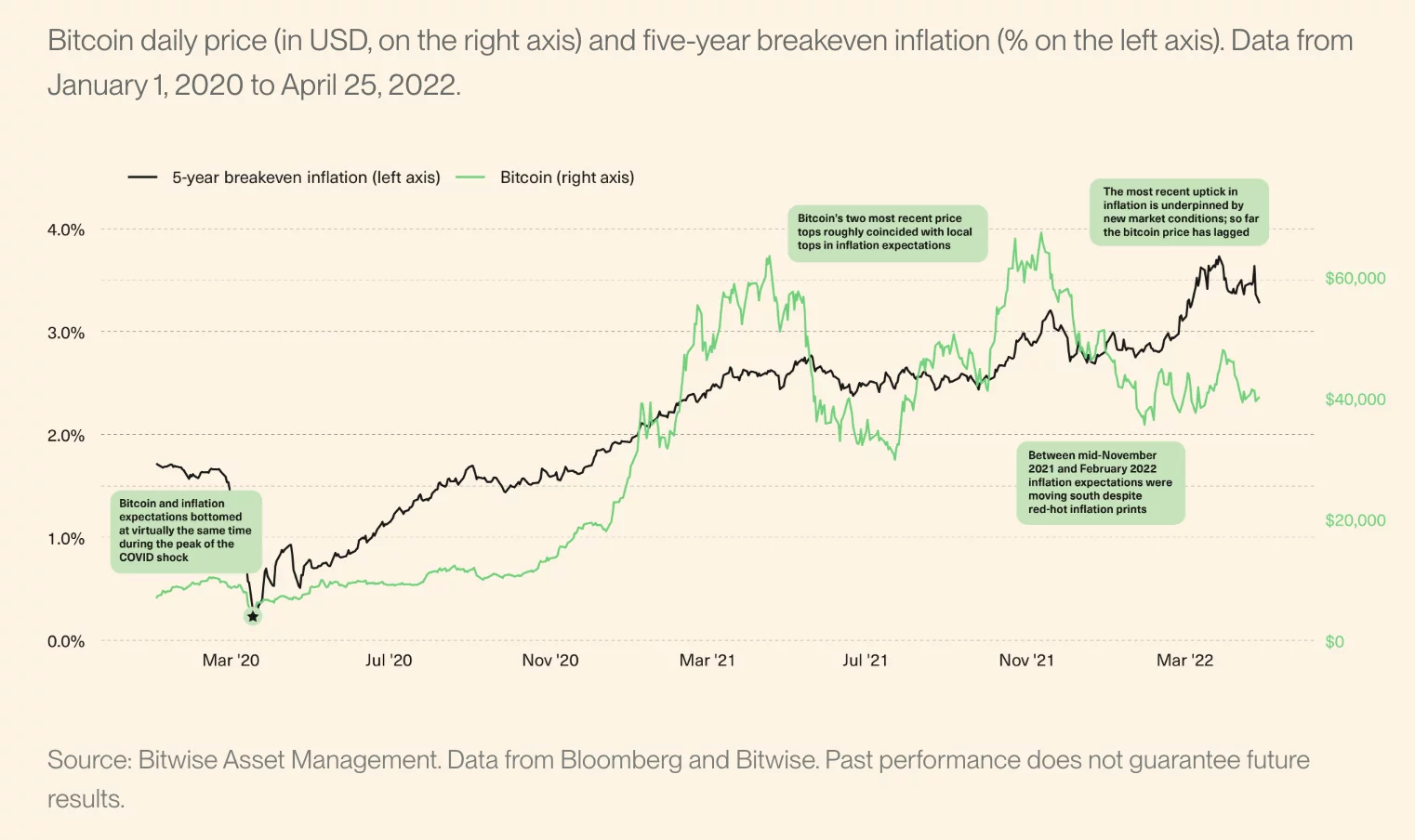
The same analysis points out that Bitcoin bottomed at roughly the same time inflation expectations did in March 2020, and that local peaks in inflation expectations around April and November 2021 lined up with major Bitcoin tops, suggesting investors increasingly treat it as an “emerging monetary asset and hedge against inflation expectations.”
Yet correlation is not protection. A 2023 study summarized by PortfolioPilot bluntly concludes that “Bitcoin has not reliably protected wealth during inflationary periods,” finding that Bitcoin prices often decline in response to surprise inflation spikes as markets price in faster Fed tightening, a pattern more consistent with high beta tech stocks than with classic hedges like gold.
In that sense, Bitcoin lives at the intersection of two forces. On one side, there is the narrative hedge against debasement that attracts capital whenever inflation expectations drift toward levels like the current 4.8%; on the other, there is the brutal math of higher real yields and tighter liquidity that can crush leveraged positions, as covered in past crypto.news reporting on BTC liquidation bands and exchange heat maps.
Historical price action underlines this tension. During the 2021 to 2022 inflation spike, headline US CPI ran above 7% year on year for several months, even as Bitcoin plunged from near $69,000 to under $20,000, a drawdown driven less by inflation itself than by the fastest series of Fed rate hikes in four decades, cascading liquidations and failures like Terra and FTX, events dissected in earlier crypto.news market structure pieces.
The move in expectations to 4.8% today sits in that ambiguous space.
If investors believe inflation will stay hot while central banks remain constrained or slow to hike, the narrative case for Bitcoin and large caps such as Ethereum and other majors tracked on crypto.news can strengthen, especially as younger cohorts who already hold crypto see it as a hedge against long term currency debasement.
But if the jump in expectations is read as a trigger for more hawkish policy, traders may again treat Bitcoin less like a digital version of gold and more like a leveraged macro proxy that sells off when the cost of capital rises.
That is the core risk warning implied by a 4.8% one year expectation print for May: crypto is now deeply wired into the inflation trade, but its role is still contested and its behavior under stress looks more like a volatile derivative of the macro cycle than a safe harbor from it.
Feature,Bitcoin,DeFi,Inflation#inflation #expectations #put #Bitcoins #digital #gold #narrative #trial1779461035