
Key Takeaways
- Tucker Carlson called public markets “fake,” pointing to oil trading under $100/barrel despite 60+ days of war disruption.
- Bitcoin climbed to $82,000 and drew $2B in April ETF inflows as investors bypassed traditional safe-haven assets like gold.
- With the Strait of Hormuz still contested in May 2026, analysts warn record S&P 500 highs near 7,300 could reverse fast.
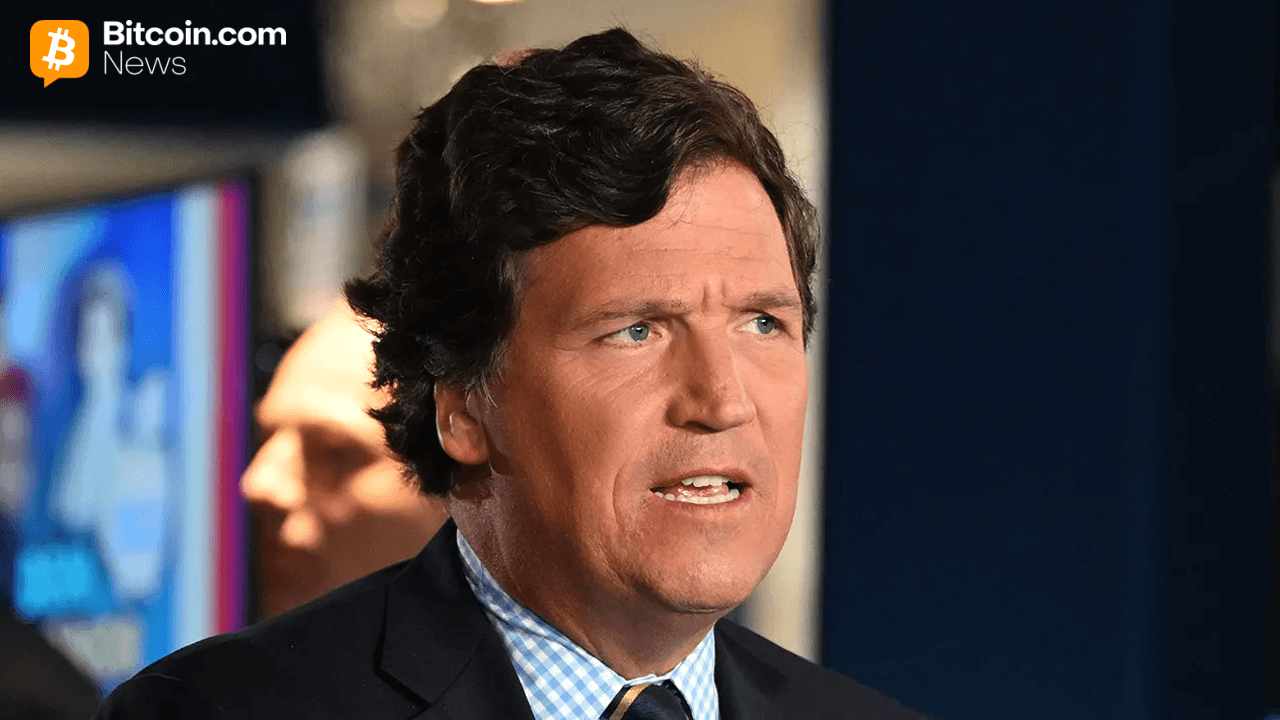
Tucker Carlson: ‘Markets Are Doing Things You Would Not Expect Markets to Do’
The comments came against a backdrop that has left many analysts searching for explanations. Operation Epic Fury, the U.S.-Israel military campaign against Iran, launched on February 28, 2026. Strikes hit Iranian leadership and infrastructure. Iran responded with missiles, drones, and disruptions to the Strait of Hormuz, through which roughly 20% of global oil flows.
A fragile ceasefire emerged during the first week of April, but brinkmanship, ship strikes, and intermittent violence have continued into May. Despite all of it, equities climbed. The S&P 500 dropped roughly 10% in the initial weeks, then staged a sharp recovery, closing above 7,000 in mid-April and trading near 7,389 by May 8. The Nasdaq 100 logged a 13-day winning streak, its longest in over a decade. The Dow approached 50,000.
Carlson pointed to oil prices as the clearest sign that something is wrong. “The Strait of Hormuz has been closed for months now, in effect,” he stressed. The political commentator added:
“And yet oil, as of airtime tonight, was under 100 bucks a barrel. Much lower than it was in, say, 2008. That is bizarre. But it’s more than bizarre. It’s fake.”
Brent crude did spike above $116 per barrel on May 5 amid Hormuz threats, but fell back below $100 on any signal of de-escalation. That whipsaw pattern repeated itself throughout the conflict, with traders pricing in a rapid resolution each time.
Gold told a similar story. Prices climbed to the $4,500 to $4,700 range overall but failed to deliver the sustained safe-haven rally many investors expected. Correlations broke. Inflation fears, a stronger dollar, and doubts about rate cuts kept the metal from running.
Bitcoin moved differently. It climbed to $80,000 and then near the $83,000 range, pulled in a record $2 billion in exchange-traded fund (ETF) inflows during April, and outperformed both the S&P 500 and gold in several stretches. Observers called it a digital hedge that absorbed geopolitical risk better than traditional alternatives.
Carlson saw this divergence as evidence of manipulation rather than fundamentals. “Markets are doing things you would not expect markets to do if they were behaving rationally in a free way, if they weren’t rigged,” he said. He argued that gold and oil have stayed “far lower than you would rationally expect them to stay after 60 days of terrible news.”
Wall Street analysts offered competing explanations. JPMorgan directly asked why stocks were hitting record highs without an Iran resolution, then attributed it to corporate earnings strength. Roughly 83% of S&P 500 companies beat estimates in recent quarters. Barclays analyst Stefano Pascale told the New York Times that “the market is trading assuming we have seen the worst of the conflict.”
In the same NYT editorial, ECB President Christine Lagarde called the tendency to assume “business as usual” simply strange. Still, Carlson pushed further. “It’s become too obvious to deny, over the past couple of months, that public markets are not what they told us they were, which is to say, open and free and equal for everyone to participate in,” he said.
He acknowledged retail investors have not fully absorbed this yet, but he suggested the knowledge is spreading. “Some people are getting rich from this, and most people aren’t,” he added. The debate over whether markets are rational or rigged is unlikely to be resolved while the Strait of Hormuz remains contested, inflation risks linger, and ceasefire terms stay unfinished.
History suggests equity markets tend to recover through geopolitical conflict. But history has shown some of the greatest crashes following irrational all-time highs. Whether any of these episodes fit historical patterns depends on what happens next.
News,gold,Iran,markets and prices,OILgold,Iran,markets and prices,OIL#Tucker #Carlson #Calls #Markets #Fake #Days #Middle #East #Conflict1778264571