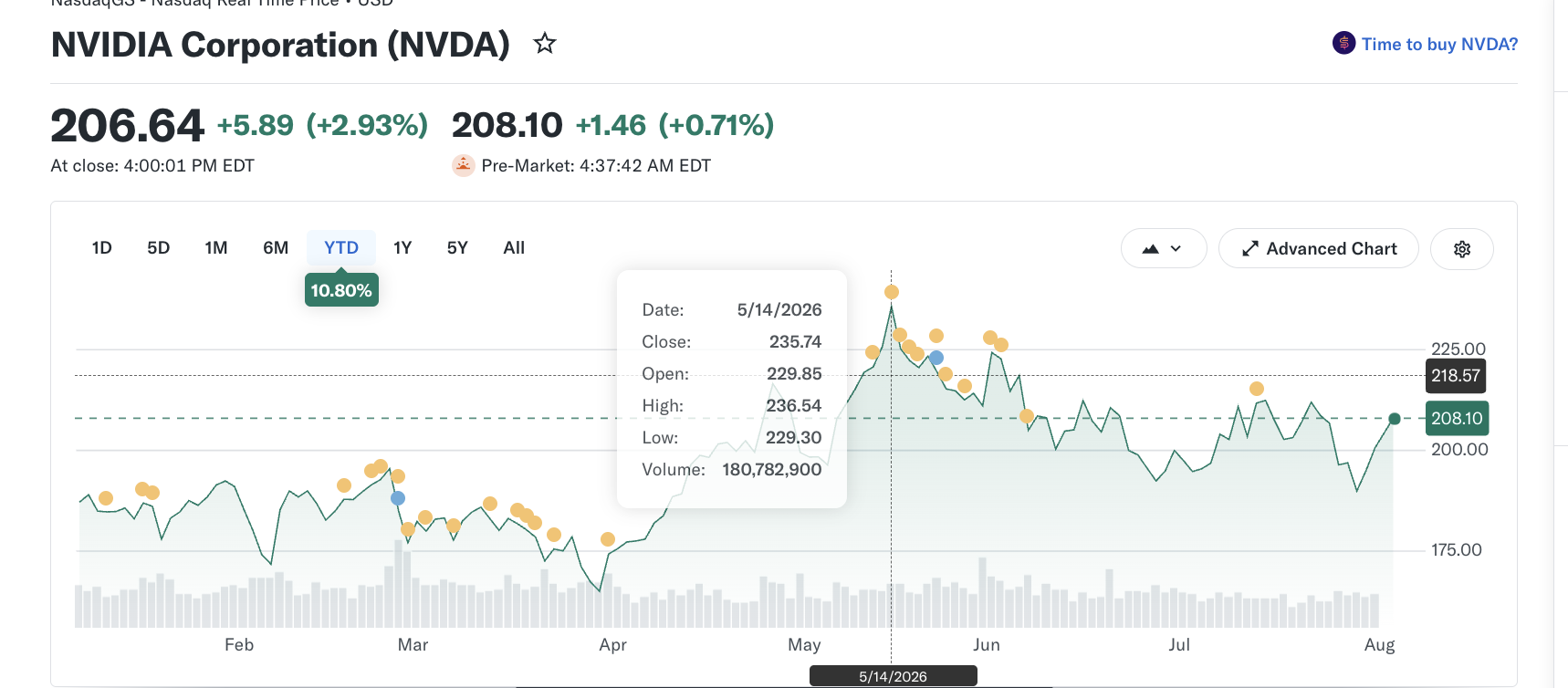

Heading into its August 26 earnings, the Nvidia stock looks strong. Nearly every analyst covering the stock rates it a buy. The shares have been higher over the past week, month, and year, and the company is expected to almost double its profit.
Nothing on the surface says caution. Yet the real risk is not on the price chart at all. It sits inside the demand everyone is celebrating, and Michael Burry, the investor who called the 2008 housing crash, has put a number on it.
The Nvidia Setup Looks Bulletproof
The tape gives the bulls everything they want. Nvidia (NVDA) has gained nearly 11% this year, bouncing from a spring low around $164 to roughly $208, even if it sits below the $236 record it set in May. The direction matters most.
The stock is now climbing into the report (starting July 29) rather than sliding into it, which usually signals the market expects good news.

The analysts are just as committed. Of the 37 firms covering Nvidia, 36 rate it a buy, one sits at hold, and not one says sell, which lands the stock at a rare Strong Buy consensus.

Their price targets point the same way. The average sits near $309, roughly 49% above where the stock trades now. The forecasts run from a low of $250 to a high of $500. Two heavyweight firms went further, as Bernstein and Wells Fargo both reiterated $315 targets days before the report.

Wall Street also expects the company to nearly double its earnings from a year ago. Moreover, the options are pricing an expected move of nearly 6% around the print.

Our look at Nvidia stock in July found the same optimism. With almost everyone already positioned for good news, even a solid quarter can fall flat. All of it rests on one assumption, that the demand is real. That is the assumption Burry attacks.
The Risk Is Inside the Results
Burry looked at where Nvidia’s demand actually comes from. The company has reportedly moved to backstop around $250 billion of debt tied to OpenAI’s data centers, helping fund the very customers who buy its chips. Put simply, it is like a shop lending you the money to buy its own goods, so the sale still counts as revenue even though the cash came from the seller.
Want more insights like this? Sign up for Editor Harsh Notariya’s Daily Newsletter here.
Burry warned that this is circular spending reaching biblical proportions, a loop in which Nvidia’s sales and its own guarantees quietly feed each other.
The uncomfortable part is who agrees.
Bernstein’s Stacy Rasgon, whose firm still rates the stock a buy at $315, has flagged the same circular-financing concern.
When the loudest bull and the loudest bear describe the same machine, the revenue line on August 26 gets harder to take at face value. The strain echoes OpenAI’s chip financing troubles from earlier this year.
Two smaller cracks sit underneath. China still holds up to $5 billion in sales that one policy shift could erase, and insiders sold roughly $410 million in stock over the past three months while the price ran high. Financing is only half the worry. The other half is whether Nvidia’s technology lead is as safe as it looks.
The Threat to Nvidia’s Lead?
DeepSeek founder Liang Wenfeng argued in remarks that spread online that new tools could lower the barriers to CUDA, the software ecosystem that keeps developers locked to Nvidia hardware. He pointed to Huawei’s Atlas 950 system as a way to take over some Nvidia workloads, though even that case admits Huawei trails by roughly two years.
Add the custom chips Google, Amazon and Meta are building in-house, and Nvidia’s dominance faces a slow squeeze rather than a sudden break.
It is the same doubt that recently weighed on beaten-down semiconductor stocks. And yet the money has not run, which turns this into a standoff rather than a verdict.
What the Big Money Is Still Doing with Nvidia Stock
Even as the warnings pile up, the flow data tells a calmer story. The Chaikin Money Flow reading, a gauge of whether institutional cash is moving into or out of a stock, shows Nvidia in accumulation rather than retreat.
This means buyers are still stepping in. Also, at press time, it is one of the two chip stocks getting institutional money.

The stock is also trading on its own terms. It has been lagging the broader SOXX semiconductor index on relative strength. In plain terms, big investors keep buying Nvidia on its own merits even as skeptics question the chips. And that split is the whole story heading into the print.

Nvidia has beaten estimates for years and its demand is still enormous. Yet, the stock trades above 30 times earnings with no room for error, and it is climbing into the report rather than hiding from it.
That is exactly when a small crack does the most damage. On August 26, the real question is not whether Nvidia beats. It is whether the demand behind that beat is as solid as 36 buy ratings make it look.
The post 36 Analysts Share Their NVIDIA Stock Forecast Before August Earnings appeared first on BeInCrypto.
Stocks,Editor’s Pick,Stock Market News#Analysts #Share #NVIDIA #Stock #Forecast #August #Earnings1785840399