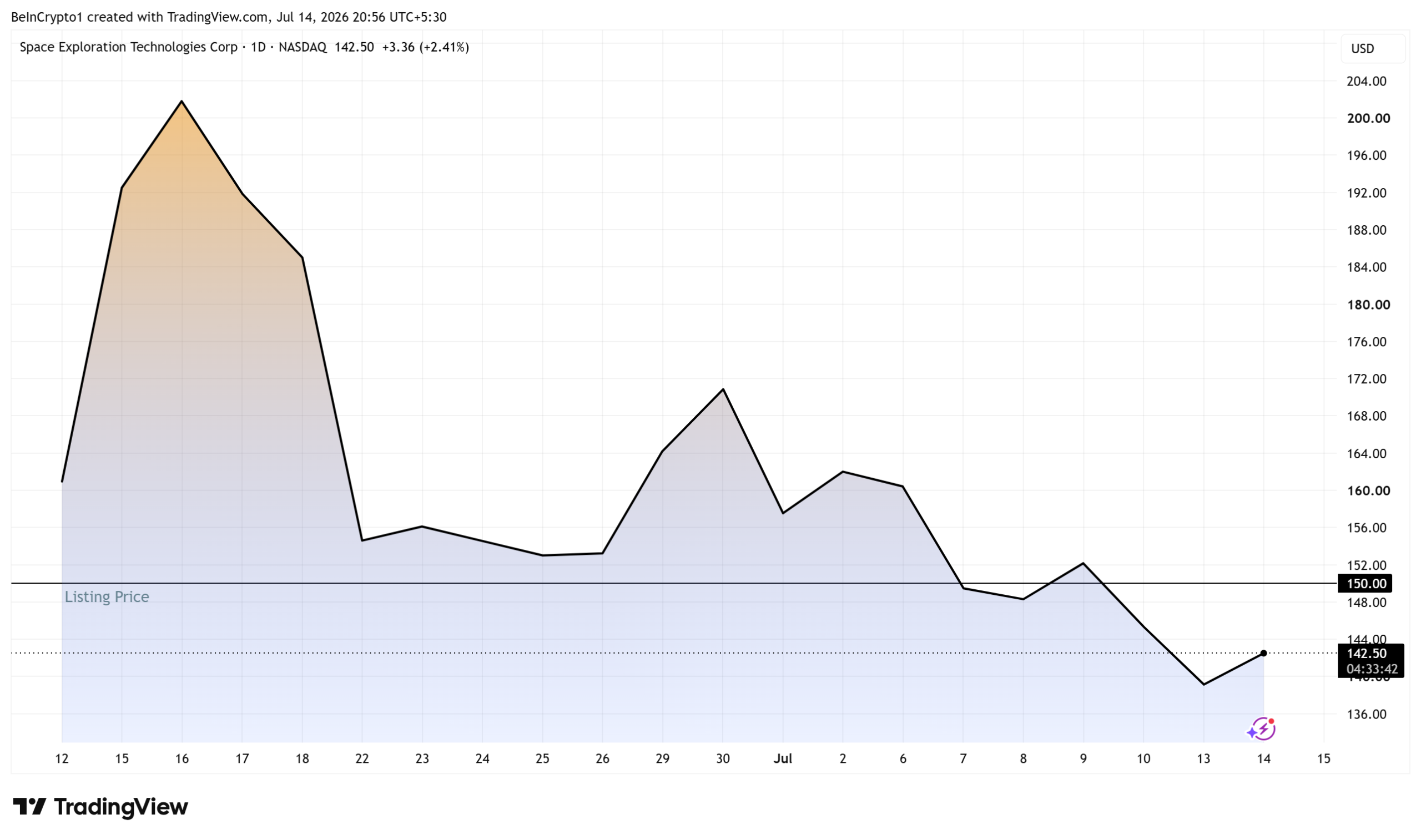

Elon Musk’s net worth has fallen more than $500 billion from its June peak of $1.45 trillion as SpaceX stock slid nearly 40% from record highs reached days after the company’s Nasdaq debut.
SPCX traded near $142.50 on Tuesday, up 1.74%, after printing an all-time low of $136.78 on Monday. Analysts argue the correction reflects profit-taking rather than any weakening in the company’s fundamentals.

Why SpaceX Stock Fell 38% From Its Peak
SpaceX (SPCX) priced its record June IPO at $135 per share and hit $225.64 on June 16. That day, Forbes reported the company had passed Amazon to become the fifth-largest US company by market value.
The math behind Musk’s loss is mechanical. He holds 4.8 billion shares, about 42% of SpaceX, according to the IPO filing. Each $1 move in SPCX therefore shifts his paper wealth by roughly $4.8 billion.
The $84 slide from peak erased close to $400 billion from that stake alone. Forbes also cut $116 billion of restricted Tesla stock from its estimate, leaving his fortune near $879 billion, still the world’s largest.
The company has shed more than $1 trillion in market value in four weeks, with its capitalization now near $1.86 trillion. The selloff persisted despite the fastest Nasdaq 100 inclusion on record and the firm’s place among the top stocks to watch this quarter.
Geopolitical risk added pressure after Iranian state media designated Musk’s Middle East operations, including Starlink, as potential military targets, CNBC reported.
Can SpaceX Stock Rebound?
Wall Street’s answer is yes, over time. Analysts view the drop as a valuation reset after post-IPO euphoria, not a broken business, so recovery depends on execution.
Evercore ISI initiated coverage on Tuesday with an Outperform rating and a $230 price target, implying roughly 65% upside. The firm’s model projects revenue compounding at 106% annually through 2028, with margins widening from 35% to 69%.
The call sits near the $236 consensus among covering brokers.
“We don’t think there’s a debate that this is an extraordinary company on a real path to reshaping the future of humanity.”
Evercore ISI analyst Kutgun Maral wrote in the initiation note, describing SpaceX as a vertically integrated operation with near-monopoly access to orbit.
Operations have not slowed with the share price. SpaceX launched 27 more Starlink satellites from Vandenberg on Monday. Starship Flight 13 follows on Thursday, carrying 20 functional Starlink V3 satellites for the first time.
That batch adds 60 terabits per second of capacity, over 20 times a single Falcon 9 load, per SpaceNews.
History offers a precedent. Facebook fell more than 50% below its 2012 IPO price within four months. The stock regained that level within 15 months as earnings caught up.

That launch cadence feeds Musk’s long-term valuation claims, while growing demand for tokenized stocks suggests retail appetite for SPCX exposure remains intact.
Still, a premium valuation and execution risk could cap near-term gains.
Thursday’s Starship flight now stands as the first major test of the rebound case. A clean mission would show the company delivering what investors are paying for, while a setback may extend the four-week correction.
The post SpaceX Stock Crash Wipes $500 Billion From Musk’s Fortune: Can It Rebound? appeared first on BeInCrypto.
Stocks,Editor’s Pick,Elon Musk News,IPO News,Stock Market News#SpaceX #Stock #Crash #Wipes #Billion #Musks #Fortune #Rebound1784047416