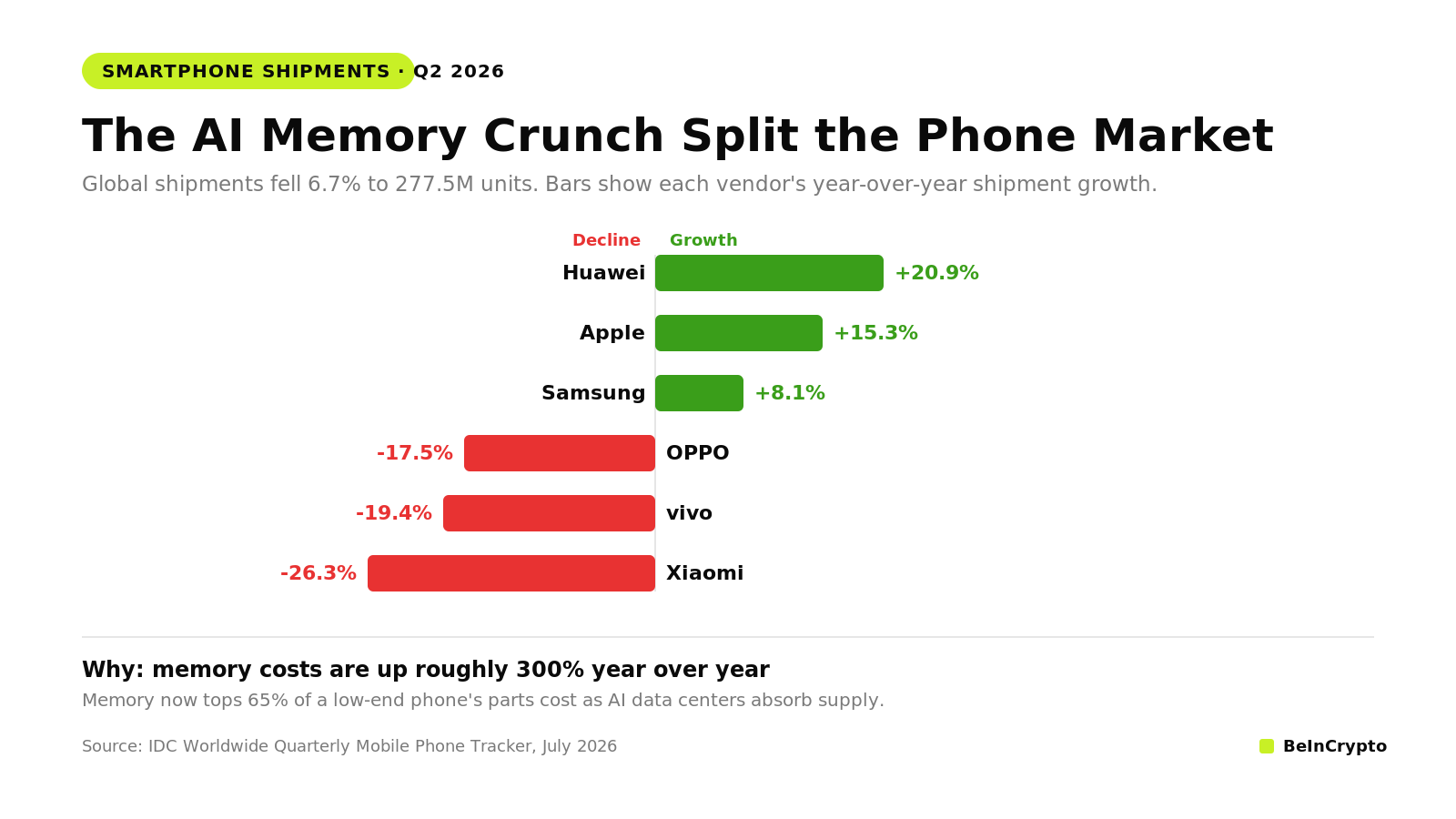

An AI-driven memory crisis is reshaping the global phone market, and Apple stock sits at a record high. Global smartphone shipments fell 6.7% last quarter, yet Apple grew 15.3% and posted record shipments.
The reason is cost. Memory chips now sell for nearly triple last year’s price, so budget phone makers raised prices and lost buyers, while premium brands with locked-in supply pulled away.
How AI’s Memory Grab Is Squeezing Phones
The squeeze starts in AI data centers. Hyperscalers are buying huge volumes of memory to train and run AI models, and that demand has drained supply for phones and PCs.
Want more insights like this? Sign up for Editor Harsh Notariya’s Daily Newsletter here.
Meanwhile, the biggest chip suppliers have chased profit. Samsung, SK Hynix, and Micron steered output toward high-margin AI memory, leaving less for consumer devices.
As a result, memory costs have climbed close to 300% over the past year, according to IDC or the International Data Corporation. Memory now makes up more than 65% of the parts cost in a cheap phone.
That shift has hit low-cost vendors hardest. Apple already passed some of the pain to buyers, raising Mac and iPad prices in June while holding iPhone prices steady.
A Smartphone Market Split In Two
The downturn is not uniform. IDC says the memory crisis has split the market, rewarding scale and premium supply while punishing cheap, high-volume phones.
The gap is stark. Apple and Samsung were the only top-five vendors to grow, up 15.3% and 8.1%. Xiaomi fell 26.3%, vivo dropped 19.4%, and OPPO slid 17.5%.

In China, Huawei and Apple stood alone with roughly 15%+ growth each, as rivals raised prices and lost hesitant buyers. Budget brands leaned on older 4G models to defend low prices as government subsidies faded.
The pattern is consistent. When the price gap narrows, buyers trade up to trusted brands rather than upgrade on the cheap.
Why The Squeeze Lifts Apple Stock
For Apple, a smaller market has meant a bigger lead. It is on track for a record 22% annual market share. Apple stock also hit an all-time high on July 13, closing at $317.31 after an intraday peak of $323.45, worth about $4.7 trillion.

Big investors positioned early. Institutions own about 81% of Apple and net-added roughly 1.24 billion shares last quarter, before its China rebound fully showed in the data.
Apple is also defending margins at the source. It is in talks with Chinese suppliers CXMT and YMTC to source memory for iPhones sold in China, which would ease the cost hit at home.
Even so, the win is relative, not absolute. The memory crisis lifts Apple against weaker rivals, but it still raises Apple’s own chip costs. So far the company has offset that by charging more, from higher Mac and iPad prices to an expected iPhone increase.
That defense has a limit. If Apple keeps raising prices, even loyal buyers may hold off, which would slow the growth now lifting the stock. The memory shortage could last into 2028, so those cost pressures are unlikely to ease soon.

The next test is close. Apple reports earnings on July 30, and that print will show whether premium demand can hold as the squeeze drags on.
The post Apple Stock Hits a Record as the AI Memory Crisis Guts Cheap Phones appeared first on BeInCrypto.
Stocks,Editor’s Pick#Apple #Stock #Hits #Record #Memory #Crisis #Guts #Cheap #Phones1784017956