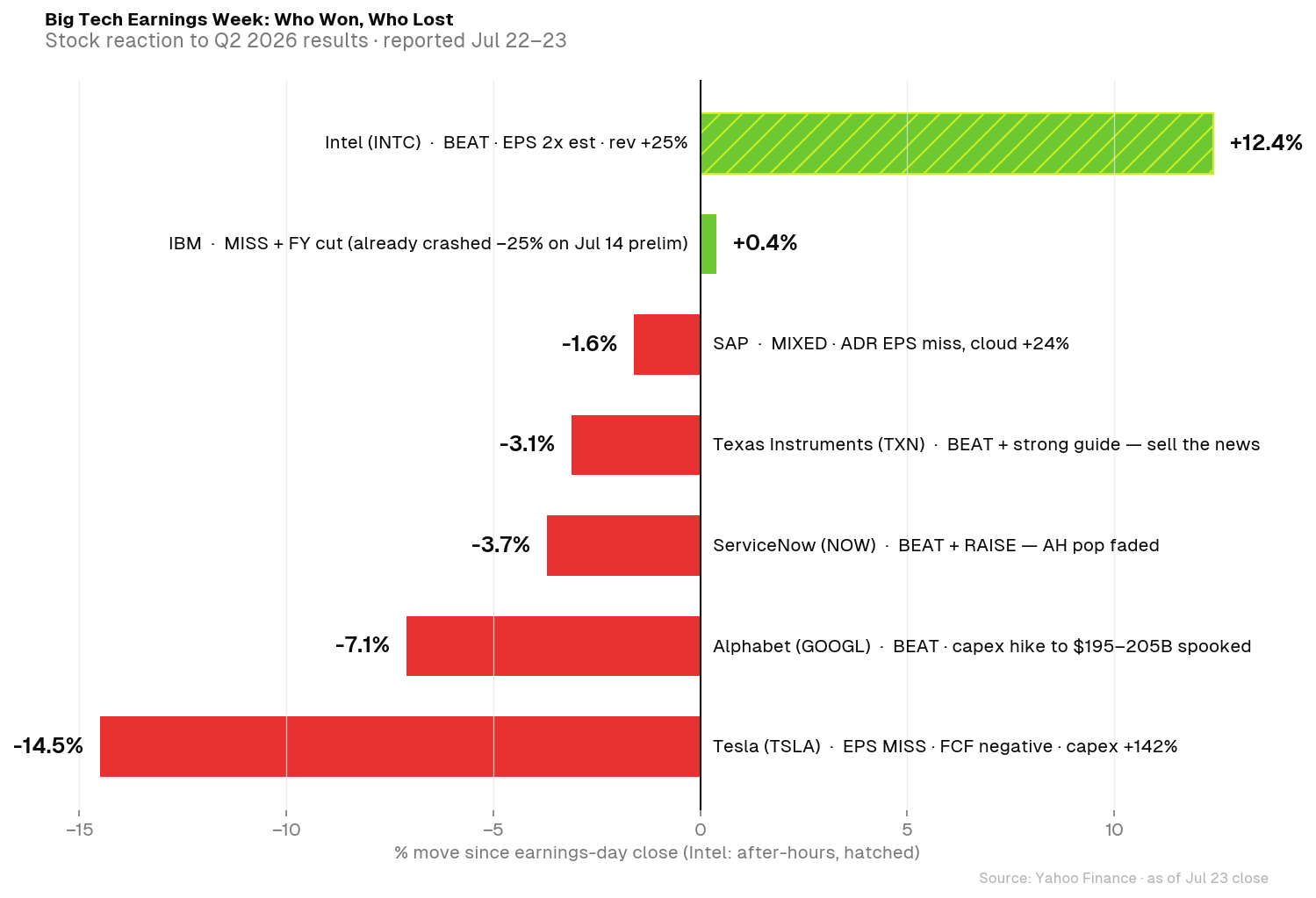

Big tech earnings week closed with a strange scoreboard. Most companies beat Wall Street’s estimates, yet almost every stock fell, and hundreds of billions of dollars in market value vanished in two sessions.

Four signals explain it better than the headlines. Price reaction, money flow, options positioning, and analyst revisions show who actually won the week.
Why This Big Tech Earnings Week Mattered
Seven heavyweights reported in four days. Texas Instruments opened on July 21, Alphabet, Tesla, IBM, and ServiceNow followed on July 22, and Intel and SAP closed the set on July 23.
The week doubled as the first real test of AI capital spending at scale, after earlier calls to dump tech into the reports. Investors wanted proof that record data center budgets are turning into profit.
Commentators estimated the megacap group shed $800 billion in a single day, the worst since April 2025.
Spending guidance now moves these stocks more than earnings do.
Who Won Big Tech Earnings Week?
Only two names left the week stronger. One won loudly on results, while the other won quietly on positioning.
Intel
Intel delivered the cleanest beat. Revenue rose 25% to $16.1 billion, its fastest growth in almost 15 years, and earnings of $0.42 per share doubled estimates. Consequently, the stock jumped more than 12% after hours.
Money tells a more cautious story. Chaikin Money Flow (CMF), a proxy for institutional money flow, sat at −0.13 into the print.

Barchart showed put/call open interest, the tally of contracts still held, at 0.96.This is a clear case of growing bearish hedging against Intel’s 0.6-0.75 baseline.

Analysts lifted targets without lifting ratings. Morgan Stanley kept its Hold at $84, and JPMorgan stayed at Sell at $85, per TipRanks.
ServiceNow
ServiceNow fell 3.7% in the session after its report, which looks like a defeat. The details argue otherwise. It beat on earnings, grew subscription revenue 24.5%, and raised its outlook.
CMF slipped to −0.10, so big money has not yet confirmed a recovery.
However, both put/call ratios fell after the print, from 0.54 to 0.42 on volume and 0.83 to 0.80 on open interest, showing bullish buildup.

Analysts raised targets at Bernstein and Evercore against a single KeyBanc Sell. Positioning treated the dip as an entry.
Who Lost the Week?
The losers shared one flaw, and it was not weak demand. Markets punished heavy spending harder than soft results.

Tesla
Tesla failed all four tests. Earnings of $0.33 per share missed the $0.51 consensus, free cash flow turned negative, and capital spending jumped 142%. The stock fell 14.5%, its worst session in over a year, capping a tense Tesla earnings preview week.
Money confirmed the damage. CMF worsened from −0.06 to −0.12, meaning sellers pressed harder on record deliveries.

Put volume climbed from 0.78 to 0.83 times calls, and at least six firms cut targets, including JPMorgan and UBS.
Alphabet
Alphabet posted the week’s best numbers and still lost. Alphabet’s July earnings showed revenue up 24% to $119.8 billion, with Cloud growing 82%, per CNBC. Yet management raised 2026 capital spending guidance to as much as $205 billion, and the stock dropped 7.1%.
That spending pushed quarterly free cash flow negative for the first time in over two decades, analysts noted, so shareholders are funding the AI buildout upfront.
The money left before the headlines did. CMF faded from 0.14 on July 20 to 0.03 after the report, so institutional buyers were stepping back all week. Analysts kept Buy ratings while JPMorgan, Piper Sandler, and UBS cut targets, and open interest edged up from 0.68 to 0.70.

Investors who had priced big earnings swings got exactly that, weeks after AI spending faced scrutiny.
Three Stocks Ended the Week Neutral
Three names finished in between, with signals pointing in opposite directions. That tension makes them the ones to watch.

Texas Instruments: The week’s broadest analyst raises, with JPMorgan going to $340, could not stop put volume doubling from 0.38 to 0.76.

Yet CMF improved to −0.03, so buyers absorbed the profit-taking dip. A mixed reaction, indeed.
IBM: It missed, cut guidance, and took the sharpest target cuts, including Morgan Stanley’s move to $190. Still, the stock closed green and CMF improved to −0.09, because the July 14 crash of 25% had already priced the pain.

The Put-Call ratio remains bullish.
Moreover, several Wall Street analysts still hold higher targets. Jefferies even assigned a post-result Buy.

SAP: Earnings on its American Depositary Receipt (ADR), the US-listed version of the German stock, missed while cloud backlog grew 27%.
Put volume collapsed from 1.99 to 0.60 as speculators exited, yet hedges rose to 1.10.

Here are all the key analyst targets, sourced directly from TipRanks.

The pattern from big tech earnings week is hard to miss.

Markets now reward companies that collect AI spending and punish those that write the checks. The week ahead will show whether money flow and fresh options data confirm Intel as the week’s loudest winner.
The post Big Tech Earnings Week is Over. Who Won and Lost? appeared first on BeInCrypto.
Stocks,Editor’s Pick,Stock Market News#Big #Tech #Earnings #Week #Won #Lost1784931702