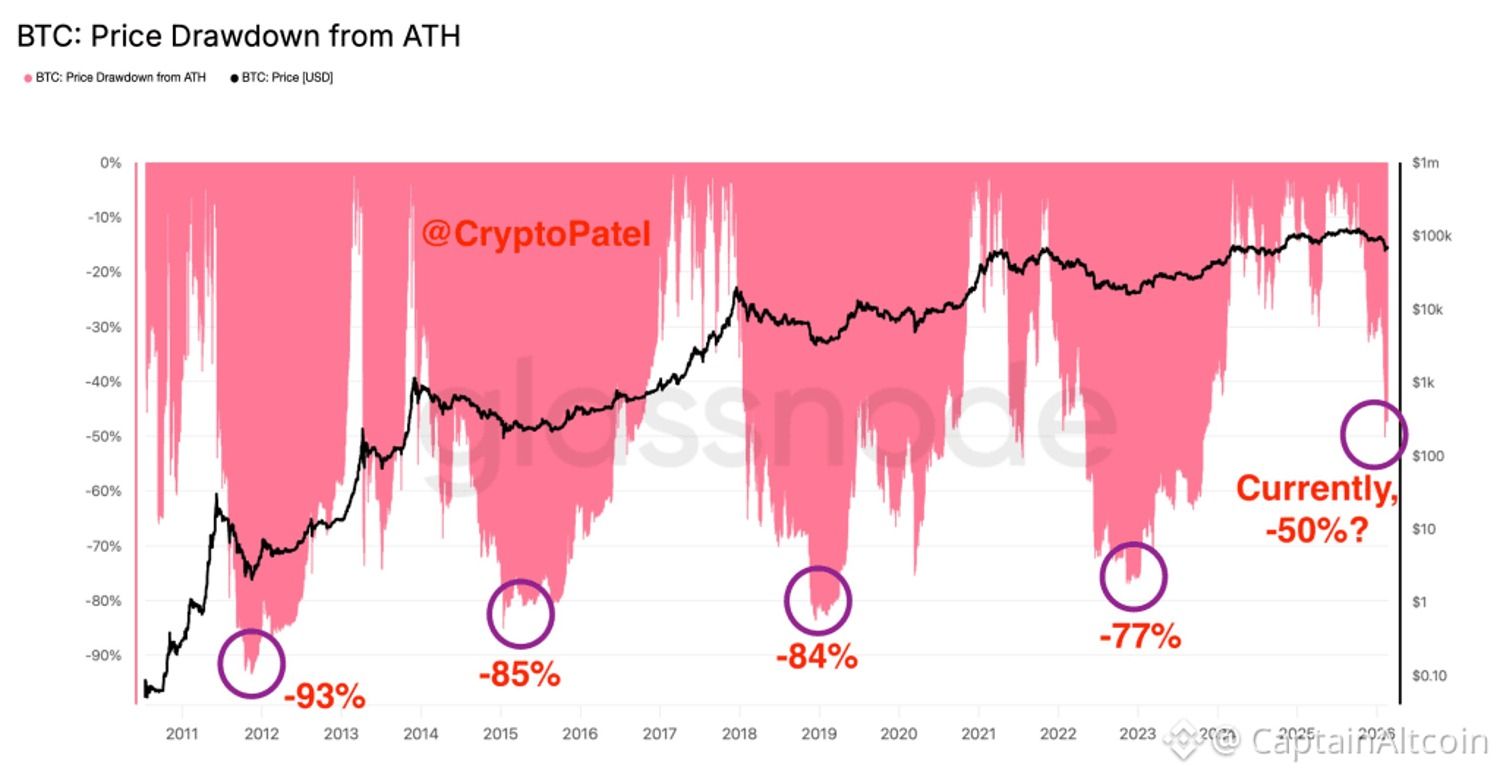

Bitcoin’s sharp fall is following the four-year cycle’s depth, slope, and timing; the selling from ETFs and Strategy and the mega-IPO liquidity drain are this cycle’s triggers, but the decline is on schedule.
- Bitcoin’s roughly 50% decline from the October 2025 peak is still in line with prior cycle behavior by depth, slope, and timing. Prior cycle lows followed about 12 months after the peak, and the current setup points to a Q4 2026 low window.
- ETF outflows and Strategy’s first Bitcoin sale in four years confirms both institutional bids behave as allocation capital rather than permanent holders.
- SpaceX, OpenAI, and Anthropic listings could pull risk capital away from crypto through mid-to-late 2026. After IPO lockups begin to expire, newly liquid employees and investors may recycle wealth into higher-beta assets, creating a potential liquidity tailwind for Bitcoin as the next cycle begins.
The Four-Year Cycle Framework
Bitcoin has moved in a four-year pattern since its first traded cycle. Peaks have arrived in late 2013, late 2017, late 2021, and late 2025. Troughs have followed roughly twelve months later: January 2015, December 2018, November 2022. The pattern has held across three complete cycles regardless of the prevailing narrative, retail-driven in 2017, institutional-curious in 2021, ETF-enabled & Bitcoin treasury companies in 2025.
Each cycle is anchored by the halving, which compresses new supply on a fixed schedule, and amplified by reflexive demand: rising price draws marginal capital, marginal capital lifts price further, leverage builds, and the structure eventually breaks. The unwind takes roughly a year. Terminal lows have arrived in Q4 of the year following the peak.
The post-ETF, post-corporate-treasury era was meant to break this pattern. Spot ETF approvals in January 2024 and Strategy’s aggressive accumulation through 2024–2025 introduced two persistent institutional bids that were expected to absorb cyclical selling and compress the drawdown.
| Cycle | Peak | Trough | Time peak→trough | Peak-to-trough decline |
| 1 | November 2013 | January 2015 | ~14 months | 85% |
| 2 | December 2017 | December 2018 | ~12 months | 84% |
| 3 | November 2021 | November 2022 | ~12 months | 77% |
| 4 (current) | October 2025 | TBD (Q4 2026 base case) | – | 50% (current) |

The Decline Sits Mid-Pattern by Magnitude
The 50% selloff is shallow relative to the 77–85% distribution of prior cycle declines. Measured against time elapsed at the 7-month mark from peak, the current decline tracks prior periods closely:
| Cycle | Drawdown 7 Months After Peak | Final Drawdown |
| 2017–2018 | Around −65% | −84% |
| 2021–2022 | Around −65% | −77% |
| 2025–Present | 50% | TBD |
If the four-year template holds, current price sits closer to the midpoint than the terminus.

Source:
The Slope Matches Prior Four-Year Templates
The shape of the move may be more informative than the depth. The current sequence, a sharp post-peak selloff, multi-month consolidation, a spring rally into the 200-day moving average, and subsequent rejection, closely resembles the pattern observed during Bitcoin’s 2018 and 2022 bear-market rallies.
Bitcoin 2018 Price

Bitcoin 2022 Price

What’s Draining the Bid?
There are several potential explanations for the current sharp selloff.
Strategy made a wrong move
Strategy sold 32 bitcoin between May 26 and May 31, its first net disposal in four years. At $2.5 million the sale is immaterial.
The decision now looks like a huge mistake. A firm that genuinely needed to fund an ongoing obligation through Bitcoin sales would sell size quietly and raise real cash before the market repriced its intent. Selling a tiny token amount and announcing it does the reverse: it signals that the largest corporate holder is now a seller and invites everyone in the market to front-run the next sale.
A mega-IPO cycle is pulling risk capital
SpaceX, OpenAI, and Anthropic are set to raise more than $240 billion combined from June through year-end, a capital pull larger than every venture-backed US IPO since 2000 combined. SpaceX’s roadshow opens June 4, with pricing June 11 and first Nasdaq trading June 12, targeting a $75 billion raise at a $1.75 trillion valuation, of which roughly $22 billion is reserved for retail.
As we put in our March article:
The AI mega-IPO cycle creates a near-term liquidity headwind for Bitcoin via ETF flow compression, but reverses into a tailwind post-lockup, as newly liquid employees and insiders with above-average Bitcoin & Crypto appetite.
Related Reading: The $197 Billion Question: How the Mega IPO Wave Reshapes Capital Markets & Crypto
Spot ETFs flipped to net redemption
The May outflow was roughly ten times February’s $206 million redemption, suggesting institutions are derisking faster than price weakness alone would suggest. The reversal tracks the allocator behavior the IPO calendar predicts: freeing balance-sheet room ahead of a crowded equity supply.
Forward Implication: Cycle-Consistent Low Meets the IPO Calendar
Every prior cycle has bottomed in the same seasonal window. The 2018 low formed in December, the 2022 low in November. The four-year clock does not predict the price of the low. It predicts the timing: Q4 of the year following the peak. With the October 2025 top in place, that points to Q4 2026.
That timing now overlaps with an unusually large IPO calendar. The key macro implication is a two-step liquidity sequence: absorption first, release later. In the first phase, public-market capital is pulled toward mega-listings. That creates a plausible drain on marginal risk capital at the same time Bitcoin is moving through the cycle-consistent low window.
SpaceX is the clearest example. Its June IPO would absorb a large amount of risk capital upfront, while its phased lock-up schedule begins releasing insider liquidity through the second half of 2026, with broader liquidity available around the 180-day mark in December. That places the unlock-driven wealth-recycling phase almost directly on top of Bitcoin’s Q4 cycle-low window.
OpenAI and Anthropic extend the same logic. Their listings would draw capital into the IPO calendar first, while their eventual lock-up expirations would push additional liquidity into 2027. By then, the initial IPO demand has likely been absorbed, early gains may begin to cool, and newly liquid employees and venture investors can start reallocating into other high-beta assets.
Disclaimer: The information provided herein does not constitute investment advice, financial advice, trading advice, or any other sort of advice, and should not be treated as such. All content set out below is for informational purposes only.
The post BloFin Research: Bitcoin’s Sharp Fall Is on Schedule, Not Off the Rails appeared first on BeInCrypto.
Businesses,Editor’s Pick#BloFin #Research #Bitcoins #Sharp #Fall #Schedule #Rails1780581089