

Key Takeaways
- Coinbase won an Aug. 11 ADGM license to arrange and custody tokenized securities.
- Apple’s 1st Coinbase certificate shows how regulated stocks could move onchain.
- Coinbase targets non-U.S. markets as its 2 UAE hubs expand stocks and derivatives.
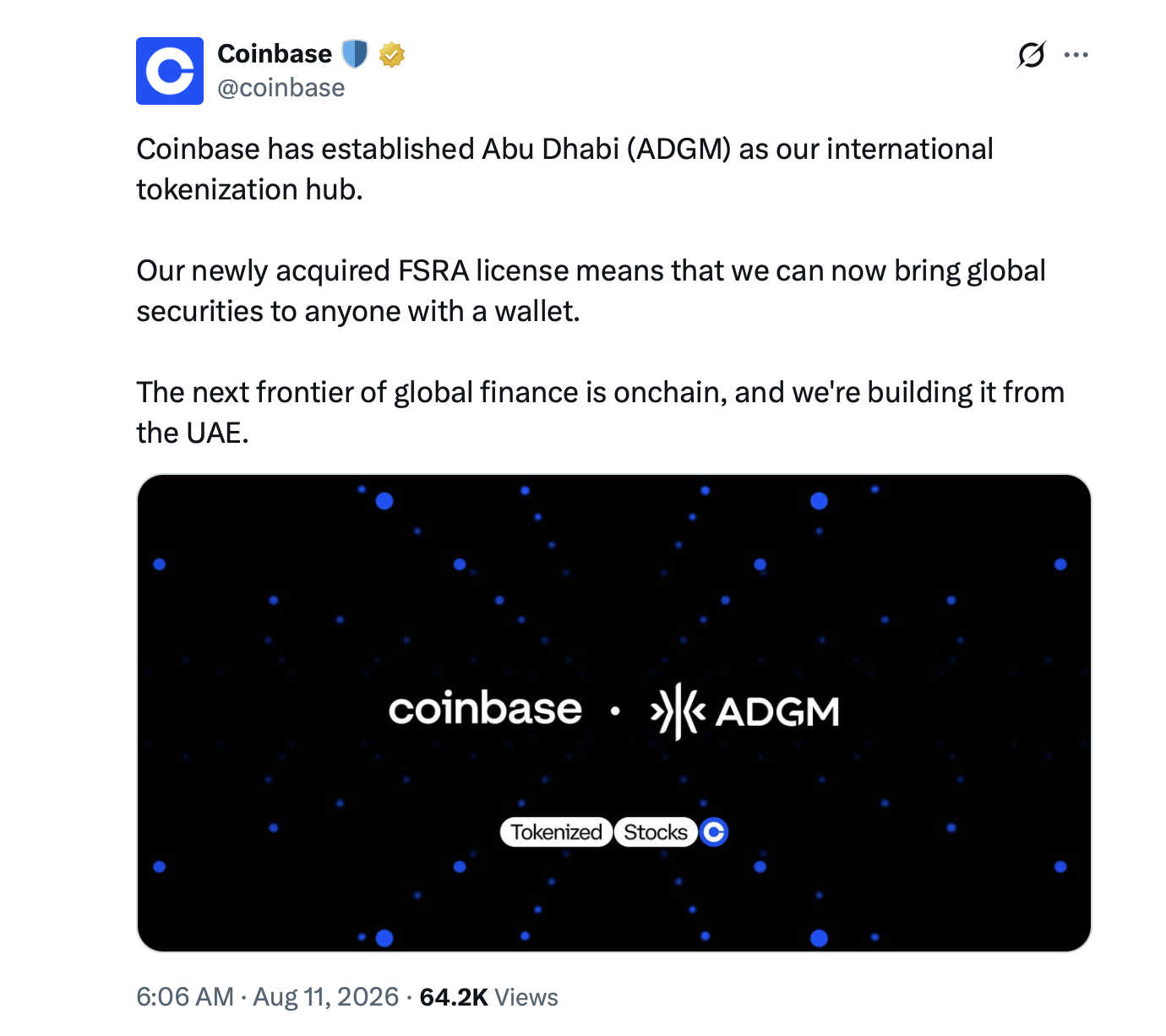
The Financial Services Regulatory Authority of Abu Dhabi Global Market, or ADGM, granted Coinbase a Financial Services Permission allowing it to arrange investment deals and provide custody services for tokenized securities. The approval was announced Aug. 11.
Coinbase Takes Traditional Stocks Onchain
Tokenization converts ownership rights in traditional assets, such as stocks, into digital tokens that can move across blockchain networks. Coinbase’s planned securities would remain regulated financial instruments while gaining some of the portability associated with crypto assets.
Under the structure, securities are issued in ADGM and backed by underlying shares held in trust. Verified token holders can receive economic benefits tied to those shares, including dividends, while voting rights may also be available depending on conditions in each offering’s prospectus.
Coinbase has already started building the machinery behind the plan. The FSRA approved a prospectus in early August for Apple CB Certificates issued by Coinbase Onchain SPV Ltd., an ADGM special purpose vehicle created in June.
Those certificates represent beneficial interests in Apple common stock, providing an early example of how Coinbase intends to bridge publicly traded shares with blockchain-based markets. Similar structures could eventually be developed around other equities.
A Wallet Could Replace the Brokerage Account
One of the biggest changes involves how investors access these tokenized securities. Eligible users can participate through digital wallets rather than relying exclusively on traditional brokerage accounts and correspondent banking relationships.
That flexibility does not mean the system is permissionless. Transfers remain subject to sanctions screening, and regulators can require assets to be frozen or seized at the wallet level. The products are also restricted to eligible jurisdictions outside the U.S.
Coinbase says the model could help address barriers that keep billions of people from meaningful access to capital markets. Essentially, blockchain-based and tokenized securities can potentially trade around the clock, settle faster and support fractional ownership, although the benefits will depend heavily on liquidity and adoption.
Abu Dhabi Becomes Coinbase’s Tokenization Base
The move deepens Coinbase’s push into the United Arab Emirates (UAE). Abu Dhabi will anchor its international tokenization and onchain capital markets operation, while Dubai serves as the center of its global derivatives strategy.
ADGM has spent years courting digital asset businesses. The financial center introduced a comprehensive virtual asset framework in 2018 and has continued developing regulations aimed at bringing institutional blockchain activity inside established financial rules.
Coinbase’s regional work also extends beyond equities. Its Project Diamond platform previously enabled institutions to issue and trade digital debt instruments on Base, while Mubadala Capital tokenized a private-markets strategy in July that attracted roughly $75 million in onchain assets.
The bigger test now is whether tokenized and blockchain-centric stocks can develop deep secondary-market liquidity and function smoothly across borders. Coinbase has the regulatory foundation and its first documented product structure. Investors will next be watching which equities follow Apple and whether wallet-based securities can move beyond a specialized international market into a meaningful new channel for global investing.
Crypto News,Coinbase,real-world assets (RWA),stocks,tokenizationCoinbase,real-world assets (RWA),stocks,tokenization#Coinbase #Builds #Abu #Dhabi #Hub #Put #Global #Stocks #Onchain1786474089