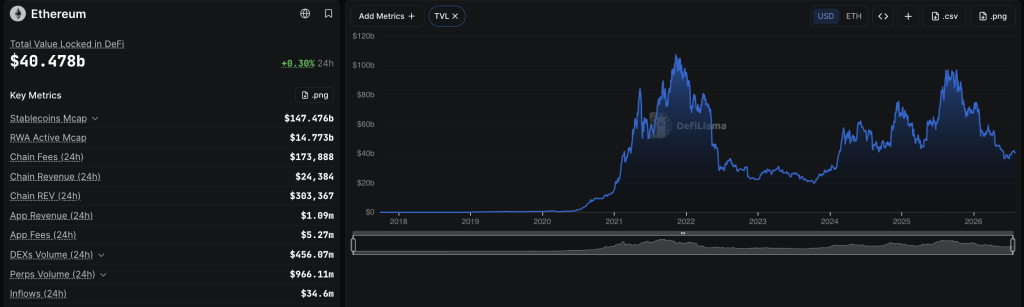

In Ethereum news today, the application layer generated $1.79Bn in fees during Q2 2026; rollups are processing 1,270 user operations per second, and $17.2Bn in real-world assets sit on-chain.
However, the ETH price remains below $2,000, roughly -60% off its all-time high near $4,950 set in August 2025. The network activity is real. The value accrual to the ETH token is not keeping pace, and that gap is now the central structural debate in the Ethereum ecosystem.
On-chain analyst @Tanaka_L2 published a detailed breakdown on July 31 that quantifies the severity of the divergence. Ethereum L1 itself captured only 4.9% of the economic value generated by its application layer in Q2, $88.4M in Real Economic Value.
This came against $1.79Bn flowing through the apps built on top of it. That ratio is the arithmetic explanation for ETH’s underperformance against both its own history and Bitcoin, which has shed roughly 11% year-to-date in 2026 while ETH has dropped by closer to 32%.
The value capture collapse stems from structural issues rather than cyclical ones. Layer 2 rollups are now the primary driver of user activity, with Tanaka’s data showing rollups at around 1,270 UOPS compared to just 20.4 UOPS on the Ethereum mainnet.
Ethereum News: The Blob Fee Era Broke the Burn Thesis

Although this scaling has worked well, the introduction of cheap blob fees to make L2 data posting affordable has diminished the fee pressure that previously led to ETH burn.
As a result, the seven-day blob fee burn was only about 0.22 ETH, which is minimal. With a 0.85% annual supply growth and a 2.6% staking yield, the dynamics supporting the “ultrasound money” concept have stalled. The ETH/BTC ratio reflects this, compressing to multi-year lows as Bitcoin benefits from consistent institutional buying.
This is all while Ethereum faces ETF outflows and lacks a strong demand anchor. Understanding these diverging flows requires analyzing the current rotation of institutional capital across altcoins, where narrative clarity is as crucial as fundamentals.
Discover: The Best Token Presales
Tanaka’s Revised Thesis: Settlement Layer, Not Gas Token
Tanaka argues that the old model of ETH is outdated and proposes a new framework in which ETH serves as reserve capital and the settlement medium for institutional tokenized finance, rather than just a fee-accruing asset. He notes that increased on-chain financial assets will boost demand for ETH as collateral and gas, shifting the demand driver away from retail transactions.
Current data supports this view, with stablecoins on Ethereum valued at about $299.4Bn and RWA tokenization reaching $17.2Bn. Tanaka emphasizes that Ethereum’s strengths lie in institutional liquidity, settlement credibility, and a significant portion of ETH supply being staked, rather than in transaction costs. This evolving thesis is gaining attention among major asset managers, despite ETH’s current price performance.
However, Tanaka highlights three key conditions for price translation: the economic scarcity of L2 throughput-generating fee revenue; active turnover of stablecoins and RWAs rather than their sitting idle; and institutions holding ETH as a reserve asset rather than merely using the network. None of these conditions has been met at a substantial scale yet.
Trade Ethereum on Bybit and Get a Chance to Win Our $1,000 USDT Airdrop
What Has to Change for ETH to Close the Gap
In other Ethereum news, the forward scenario hinges on a transition from using network activity as a metric to using it as a revenue source for L1. If RWA settlement volumes and stablecoin turnover grow to the point where blob space demand outstrips supply, fee pressure returns to L1 and the burn mechanism reactivates.
That is the path where the current technical scaling investment pays off in token terms. The alternative, sustained high activity with low L1 fees, continues to compress the ETH/BTC ratio and validates the market’s current skepticism about Ethereum’s value accrual mechanics.
ETH’s near-term price action remains constrained by macro sensitivity; ETH carries a higher Nasdaq correlation than Bitcoin, and by the absence of a near-term catalyst that directly addresses the L1 revenue capture problem. Tanaka’s position is that Ethereum is in a deliberate margin-compression phase.
It subsidized cheap execution to build ecosystem scale, and the economic return to L1 has been deferred. Whether that deferral resolves into a structural re-rating or becomes a permanent feature of the modular architecture is the question the market is currently pricing at a significant discount.
Discover: The Best Crypto to Diversify Your Portfolio
The post Ethereum Network Earns $1.79Bn in App Fees, But Captures Less Than 5% appeared first on Cryptonews.
Altcoin News,altcoin news today#Ethereum #Network #Earns #1.79Bn #App #Fees #Captures1785752212