
Japan’s Financial Services Agency has finalized rules allowing foreign-issued trust-type stablecoins into its payment system, with the changes published on May 19, 2026, and effective June 1.
The decision reshapes how global stablecoins enter Asia and arrives as Washington advances its own crypto legislation.
What Japan’s New Stablecoin Rules Actually Mean?
A trust-type stablecoin is a digital token fully backed by reserves held in a trust structure, redeemable at par with a fiat currency. Japan’s updated framework now lets qualifying foreign versions act as regulated payment instruments.
Until now, foreign-issued stablecoins faced real regulatory friction inside Japan. Regulators often classified many of them as securities or left them in a gray zone that blocked everyday payment use.
The reform, published under Prime Minister Sanae Takaichi, reclassifies qualifying foreign trust-type stablecoins as Electronic Payment Instruments under the Payment Services Act. That single change integrates them into Japan’s formal financial rails.
Follow us on X to get the latest news as it happens
At its center sits a rigorous equivalence standard. Foreign issuers must prove their home jurisdiction matches Japanese rules on licensing, auditing, anti-money laundering controls, and same-currency reserves to limit exchange-rate risk.
Domestic intermediaries carry the first responsibility for verifying compliance. Major local players are already preparing, with SBI VC Trade exploring licensed services involving global stablecoins such as USDC.
In this way, the June 1 start date will be closely watched. Success could accelerate inflows of global capital and unlock new payment applications, from remittances to tokenized settlement systems.
How the United States CLARITY Act Fits the Scene?
Across the Pacific, the United States is advancing its own crypto framework. The Senate Banking Committee recently moved the CLARITY Act forward with a bipartisan vote of 15 to 9.
The Digital Asset Market Clarity Act seeks to define regulatory jurisdiction between the SEC and the CFTC. It also builds on the earlier GENIUS Act to address stablecoin-related issues directly.
One key compromise involves yield. The bill generally prohibits passive, deposit-like interest on payment stablecoins while still allowing activity-based rewards for users.
“Congress has an opportunity, before this bill advances further, to close the loophole tightly and ensure that any prohibition on stablecoin interest is airtight — applying not just to issuers but to exchanges, affiliates, and any intermediary delivering the same economic return through a different corporate wrapper,” said Jeane Vidoni, CEO of Penn Community Bank.
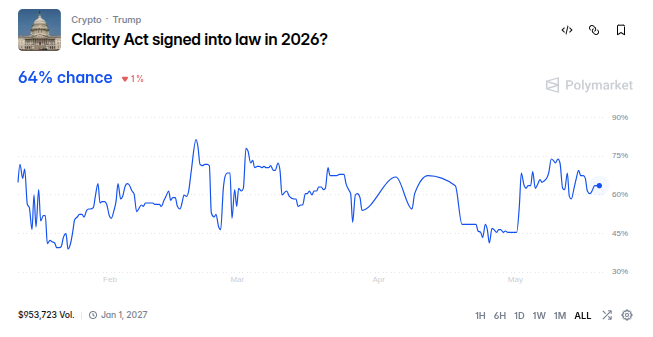
Analysts are cautiously optimistic. Alex Thorn of Galaxy Digital estimates the chance of the CLARITY Act becoming law in 2026 at roughly 65% to 75%, up from earlier near-even odds. Meanwhile, traders on Polymarket assign a 64% probability that the bill will become law in 2026.

Together, both stories point in the same direction. Japan’s regulatory refinement and America’s legislative push highlight a maturing global stablecoin ecosystem moving steadily from early experimentation toward real, structured integration.
For issuers and intermediaries, this dual momentum signals that clarity is finally arriving, one jurisdiction at a time. Regulated frameworks on both sides of the Pacific could unlock cross-border payments, institutional adoption, and more transparent, inclusive financial systems worldwide.
Subscribe to our YouTube channel to watch leaders and journalists provide expert insights
The post Japan is Adopting a Reverse CLARITY Act With Foreign Stablecoins appeared first on BeInCrypto.
Markets,Cryptocurrency Market News,Editor’s Pick,Japan News,Stablecoin News#Japan #Adopting #Reverse #CLARITY #Act #Foreign #Stablecoins1779231172