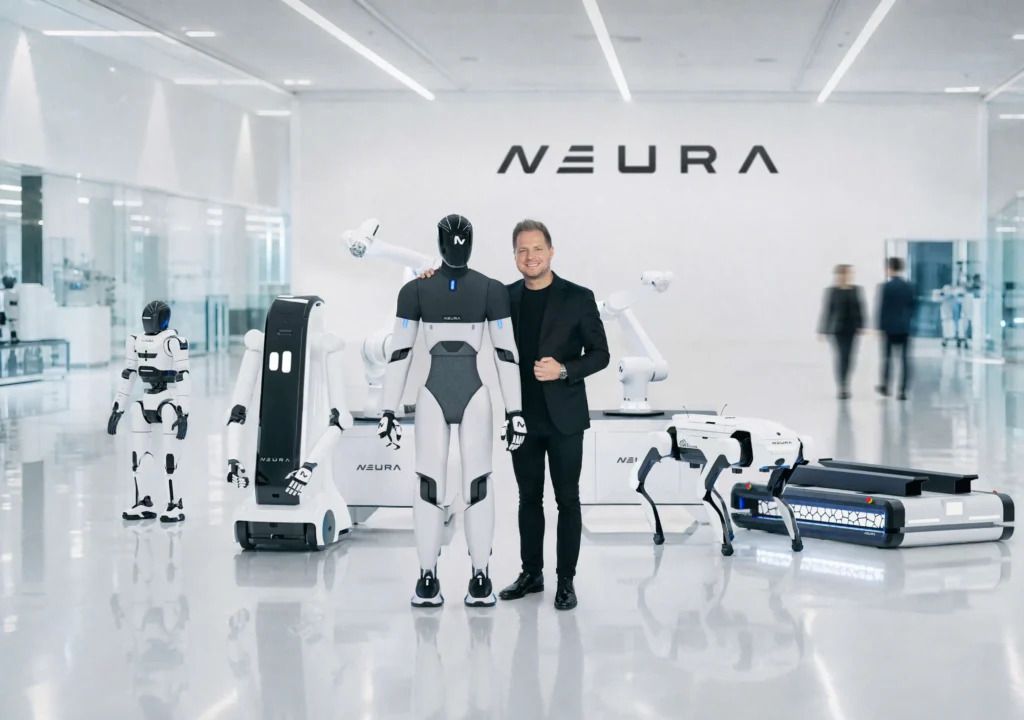

Stablecoin issuer Tether will lead a funding round of up to $1.4 billion for German firm NEURA Robotics. The deal ranks among the largest private investments in humanoid robotics to date.
Beyond the capital, the partnership embeds Tether’s payment and AI technology directly into NEURA’s machines. As a result, the stablecoin giant moves closer to its vision of a machine economy.
Inside the Tether NEURA Robotics Funding Round
Tether confirmed the Series C investment in an official announcement. Moreover, the round drew Nvidia, Amazon, Qualcomm, Bosch, Schaeffler, and the European Investment Bank.

The investor list reflects a wider shift. Chipmakers, cloud giants, and European industrial firms all want exposure to humanoid hardware. In addition, public lenders such as the EIB now treat the sector as a strategic priority.
NEURA, based in Metzingen, builds humanoids, precision robotic arms, autonomous mobile robots, and service robots. According to the company, the deal marks a step into Physical AI and next-generation industrial automation.
The move also extends Tether’s billion-dollar robotics plan, which already covers Blackrock Neurotech and Generative Bionics. Meanwhile, the issuer has the cash to back it. Tether posted a $1.04 billion profit in the first quarter of 2026.
Building the Machine Economy
Both firms frame the partnership as infrastructure for a machine economy. In that model, robots operate, transact, and make decisions with far greater autonomy than today.
Tether will also integrate two core technologies into NEURA’s software ecosystem, Neuraverse. First, the open-source Wallet Development Kit enables robots to create self-custodial wallets.
Consequently, machines could receive payment for completed tasks and transact autonomously.
Second, Tether will deploy its edge-first AI runtime, which runs models directly on devices. The company has positioned its QVAC platform as the backbone of on-device intelligence.
In contrast to cloud-based systems, this design keeps data and decisions on the robot itself. Therefore, wallet-equipped machines could work in factories or homes without constant connectivity.
The timing stands out, however. USDT supply contracted earlier in 2026 after billions in token burns. Even so, Tether continues to spend on robotics, AI, and infrastructure at full speed.
Whether robots become real stablecoin users remains an open question. Execution will decide it, because no robotics firm has shipped wallet-equipped machines at scale. Still, the coming months should show how quickly NEURA can deliver hardware that pays for itself.
The post Tether Leads $1.4 Billion Funding Round for NEURA Robotics appeared first on BeInCrypto.
Markets,AI News,Editor’s Pick,Tether (USDT) News#Tether #Leads #Billion #Funding #NEURA #Robotics1781186548