

Bitcoin has slipped over 2% toward $62,000 after President Donald Trump reinstated an Iranian blockade in the Strait of Hormuz and announced new cargo fees for ships crossing the waterway.
Summary
- Bitcoin fell below $63,000 after Trump announced the return of the Iranian blockade in the Strait of Hormuz.
- Trump said the U.S. will charge a 20% cargo fee while protecting commercial shipping through the strategic waterway.
- Polymarket traders now see only a 16% chance that Hormuz shipping will return to normal by Aug. 31.
According to a July 13 Truth Social post by President Trump, the renewed blockade will target only Iranian ships and customers while allowing all other countries to continue using the Strait of Hormuz.
The announcement comes as tensions between the United States and Iran have intensified again following fresh attacks around the key oil shipping route.
Trump stated that the Strait of Hormuz would remain open “with or without Iran” and declared that the United States would now be known as “THE GUARDIAN OF THE HORMUZ STRAIT.”
He added that Washington would collect a 20% reimbursement on all cargo shipped through the passage with U.S. protection, saying the payment would cover the costs of maintaining safety and security in what he described as a volatile region.
The president also said implementation would begin immediately. The latest announcement follows his earlier proposal for the United States to take control of the Strait of Hormuz and introduce transit fees, an idea that came after Iran discussed imposing its own tolls on vessels crossing the chokepoint.
Bitcoin weakens as geopolitical risks return
Alongside the renewed geopolitical uncertainty, Bitcoin (BTC) has extended its retreat from levels above $64,000 reached earlier this week. The cryptocurrency is changing hands near $62,240 at the time of writing, down nearly 3% over the past 24 hours.
The daily chart also points to weakening momentum after Bitcoin failed to hold above the 78.6% Fibonacci retracement near $63,200 and slipped back below the 50-day simple moving average around $64,650. Price continues to trade inside a descending channel that has been in place since May, while the 100-day and 200-day moving averages remain much higher near $70,700 and $73,800, respectively.
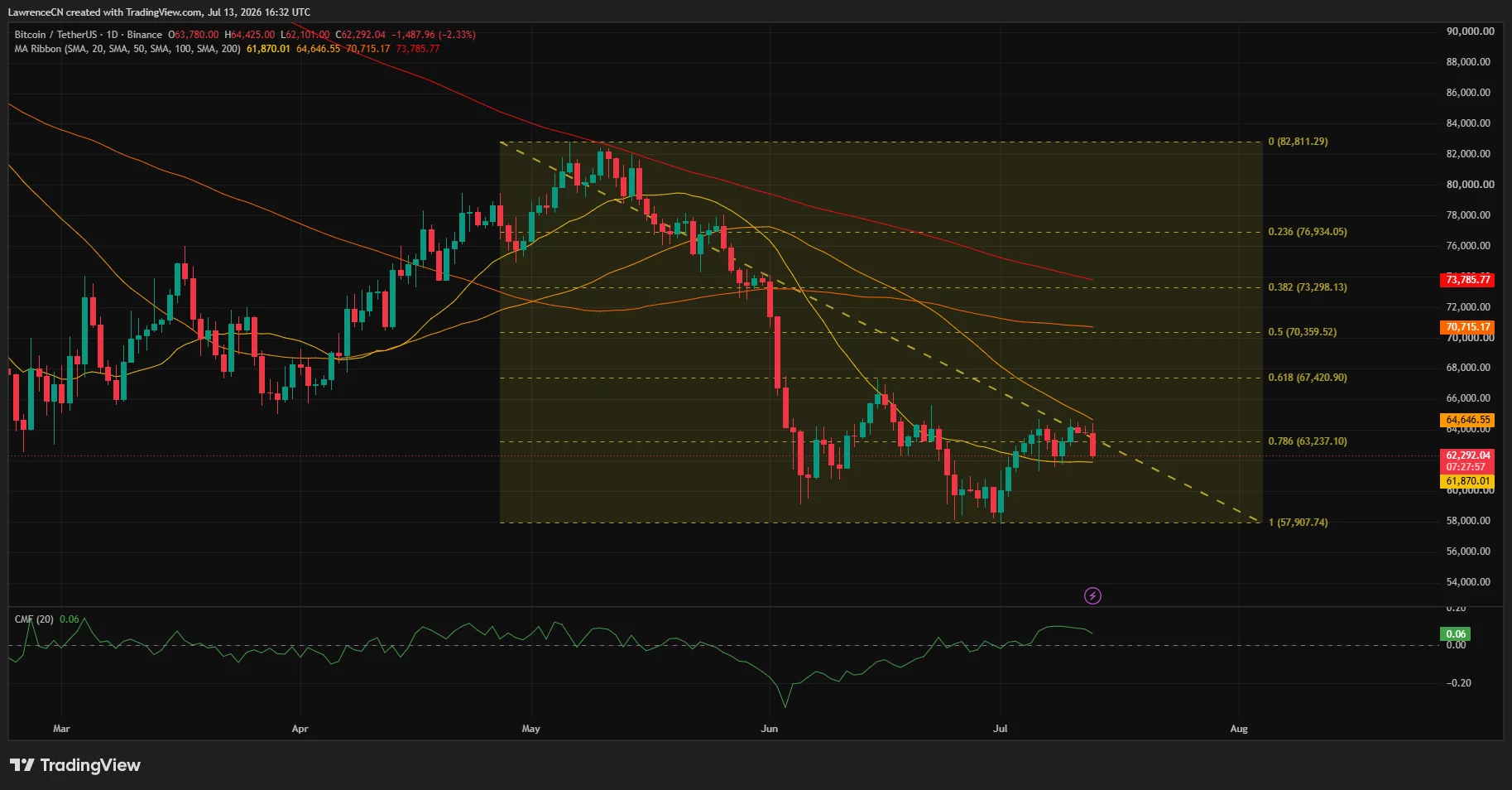
Despite the decline, the Chaikin Money Flow indicator remains slightly positive at around 0.06, suggesting capital inflows have not completely reversed. Still, technical resistance between roughly $63,200 and $64,600 continues to cap recovery attempts, while support sits near the 20-day moving average around $61,870 before the psychologically important $60,000 level.
Traders reduce expectations for shipping recovery
Meanwhile, prediction markets indicate that traders have become increasingly pessimistic about shipping conditions returning to normal in the Strait of Hormuz.
According to data from crypto prediction platform Polymarket, the probability that maritime traffic will normalize before Aug. 31 has dropped to just 16%. Those odds have fallen sharply from nearly 48% earlier this month after Trump declared that the previous ceasefire was over.
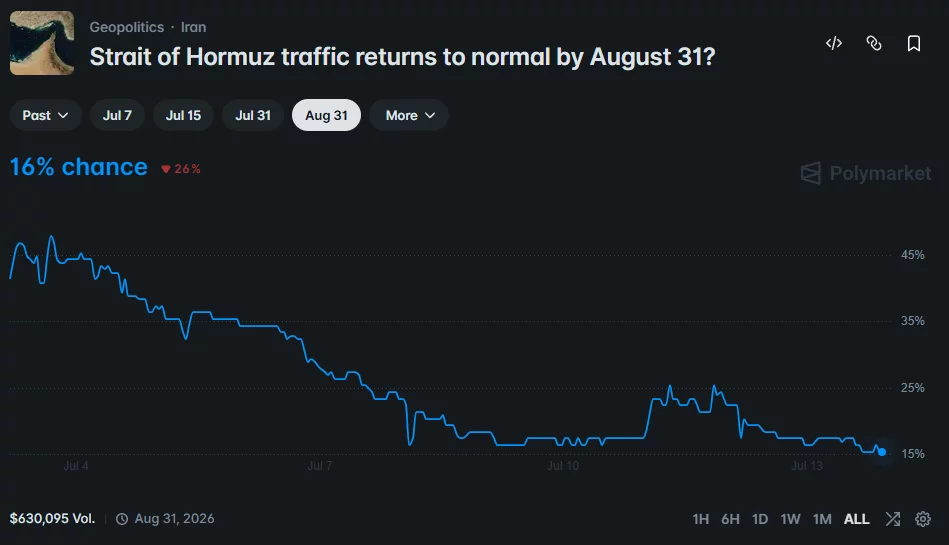
The latest decline follows several days of military escalation between Washington and Tehran. Iran’s Navy has announced that the Strait of Hormuz will remain closed until further notice, while Iranian forces have reportedly struck multiple vessels operating in the waterway in recent days as the country seeks to tighten its control over the strategic oil corridor.
With geopolitical tensions continuing to escalate and uncertainty surrounding one of the world’s most important energy routes growing, risk assets such as Bitcoin remain under pressure as investors closely monitor developments in the region.
Markets,Bitcoin,Donald Trump,Price Analysis#Trump #revives #Hormuz #blockade #Bitcoin #slips #62K1783962171