

Arthur Hayes, the BitMEX co-founder, confirmed today that he liquidated his entire Zcash (ZEC) position after a protocol bug in the Orchard Pool. Zcash’s core shielded transaction layer bug was disclosed publicly, compounding an already difficult few weeks for ZEC.
The move completes the full liquidation of his self-described ‘Holy Trinity’ portfolio, which previously included HYPE and NEAR tokens.
The central question the market is now asking is not whether Hayes was right to exit, the bug is real, the risk is documented, but whether this was a cold-eyed protocol risk assessment or a reactive flush after a vulnerability shook his conviction in privacy coins as a category.
The evidence points heavily toward the former. That distinction matters for anyone trying to read this exit as a signal.

Discover: The Best Crypto to Diversify Your Portfolio
The Orchard Pool Bug: What the Vulnerability Actually Means for ZEC
The Orchard Pool is Zcash’s next-generation shielded transaction circuit, introduced with the NU5 upgrade in May 2022.
It replaced the older Sapling pool and brought trustless zk-SNARKs via the Halo 2 proving system, no trusted setup required. The pool exists specifically to enable fully private transfers, and its cryptographic soundness is not a feature; it is the entire value proposition of ZEC.
The bug, identified on May 29, 2026, by security engineer Taylor Hornby of Shielded Labs, using AI-assisted formal methods including Anthropic’s Claude Opus 4.8, was an insufficient constraint in elliptic-curve multiplication inside the halo2_gadgets crate.
https://t.co/v7BiOdzU9E
— zooko
ⓩ (@zooko) June 4, 2026

In easy terms, crafted inputs could theoretically bypass the circuit’s validity checks and produce counterfeit ZEC that still passed Orchard’s verification.
An emergency hard fork was activated on June 3, 2026, patching the flaw. But the window from NU5 activation in 2022 to the June 2026 patch represents nearly four years during which the bug existed undetected, surviving multiple expert audits.
Here is the part that matters for holders: due to Orchard’s privacy architecture, it is cryptographically impossible to prove that counterfeit ZEC was never minted during that window.
No evidence of exploitation exists, but the inability to attest total supply integrity is not a footnote; it is a fundamental crack in the sound money narrative that Electric Coin Co. has built around ZEC.
Hayes Exits Zcash: Protocol Risk Reaction or the Same Pattern Playing Out Again?
Hayes had publicly flagged Zcash as a high-conviction holding, part of the ‘Holy Trinity’ alongside HYPE and NEAR, a trio he framed as his asymmetric altcoin bets.
He had already cleared HYPE and NEAR before turning to ZEC, a sequencing that some read as methodical de-risking rather than panic.
The ZEC exit followed the Orchard bug’s public disclosure and the June 3 hard fork, meaning Hayes moved after the vulnerability was known, not before.
His stated rationale was direct: ‘The probability of unauthorized minting is extremely low, but it cannot be proven cryptographically impossible,’ he wrote. And further: ‘The narrative of protecting privacy from AI, governments, and Big Tech demands perfection, a standard the bug undermined.’
That framing is not a trader’s excuse. It is a thesis statement. Hayes was long ZEC because privacy coins occupy a unique ideological and technical niche, and that niche requires cryptographic certainty that Orchard can no longer provide without qualification.
The pattern here is familiar to anyone who has tracked Hayes’s public portfolio moves. Fresh conviction, public endorsement, then a clean exit when the underlying thesis breaks. Whether that is disciplined risk management or the ‘shill, pump, dump, repeat’ cycle this site has previously documented is a judgment call, but the Orchard bug gives this exit a harder-to-dismiss fundamental rationale than most. He continues to hold Worldcoin (WLD), which was never part of the Trinity framework.
ZEC Price and Market Structure: The Damage Is Real
ZEC dropped 30–36% from recent highs following the bug’s public disclosure, falling from above $600 to approximately $390, erasing over $3 billion in market cap.
The move broke the 20-day, 50-day, and 100-day EMAs in sequence, with traders now watching 200-day EMA support near $367 as the next critical level.
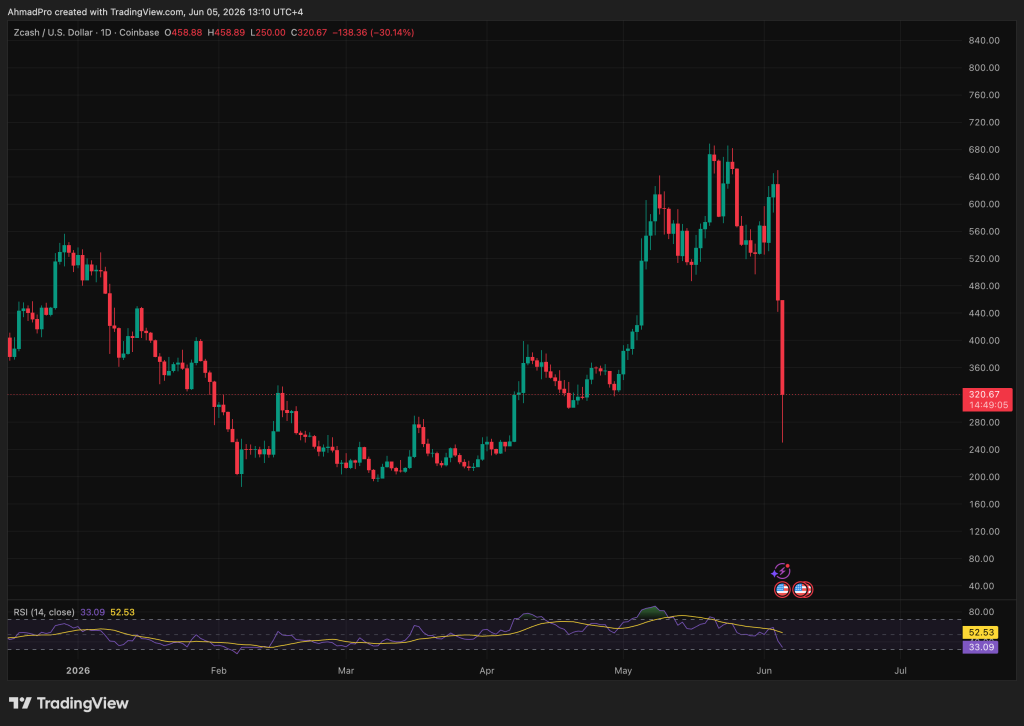
Hayes’s exit itself occurred on normal trading volumes, suggesting his position did not mechanically move price; the market was already pricing in protocol risk before his announcement landed.
The structural read is bearish until the $430–$450 zone is reclaimed on a closing basis. Below $367, ZEC enters uncharted technical territory with limited historical support to reference.
Discover: The Best Token Presales
The post Arthur Hayes Just Dumped His Entire Zcash Position After a Bug That Could Have Allowed Counterfeit ZEC for 4 Years appeared first on Cryptonews.
Altcoin News#Arthur #Hayes #Dumped #Entire #Zcash #Position #Bug #Allowed #Counterfeit #ZEC #Years1780669071